|
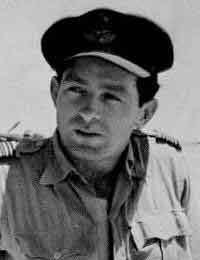
'Woody' Woodward was born in Victoria, British Columbia, on 22 December 1916. Unable to consider the RCAF as he did not have a degree, he sailed for the UK in 1938, staying initially with an uncle who had served in the RNAS in the first war, and had remained in England to farm in Gloucestershire thereafter.
He attended Civil Flying School at Perth, Scotland, in June 1938, and on 20 August was accepted for a short service commission in the RAF and gazetted as Acting Pilot Officer on Probation.
Between 5 September 1938 and 15 April 1939, he attended 6 FTS at Little Rissington.
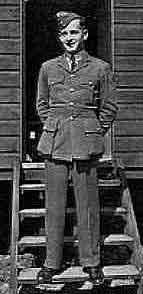 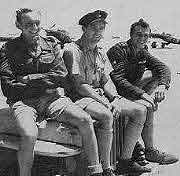
On 20 May 1939, he was posted to Egypt to join 33 Squadron, where he became a Flying Officer on 2 September. Following the Italian entry into the war in June 1940, he was to gain early success over the Libyan frontier area during June and July.
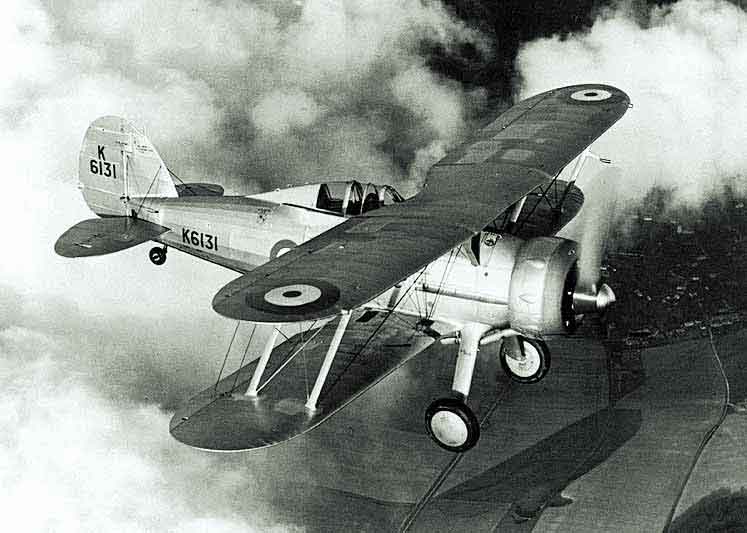
Gloster Gladiator
In June 1940, 33 Squadron was based at Mersa Matruh, commanded by Squadron Leader D. V. Johnson and equipped with 21 Gladiators (mainly Mk.IIs) (on 11 June) and six Gloster Gauntlets Mk.IIs kept in reserve. It had 22 pilots in three flights:
'A' Flight included Flight Sergeant Leonard Cottingham, Sergeant Roy Leslie Green, Flying Officer Monk, Pilot Officer Eric Woods, Pilot Officer Brown, Pilot Officer Preston, Pilot Officer Perry St. Quintin and Flight Lieutenant G. E. Hawkins.
'B' Flight included Flying Officer Ernest Dean, Sergeant Shaw, Pilot Officer Woodward, Sergeant J. Craig, Flying Officer Couchman, Flying Officer John Littler and Pilot Officer Alfred Costello.
'C' Flight included Flight Lieutenant Bolingbrooke, Sergeant William Vale, Pilot Officer E. K. Leveille, Flight Sergeant Harry Goodchild, Flying Officer Henry Starrett and Pilot Officer Boulton.
14 June 1940 saw the first combats between opposing RAF and Regia Aeronautica fighters over North Africa. This was caused because the 11th Hussars (Prince Albert's Own), joined by elements of 4th Armoured Brigade and 1st Battalion, King's Royal Rifle Corps, assaulted Fort Capuzzo and Fort Maddalena (the two most important Italian frontier posts). The offensive was supported by attacks by Blenheims from 45, 55, 113 and 211 Squadrons. To protect both bombers and ground forces, 33 Squadron flew offensive sweeps as far as Bardia, meeting the Regia Aeronautica two times in the morning.
At 07:35 Flying Officer Ernest Dean, Flying Officer R. A. Couchman, Pilot Officer Woodward and Pilot Officer A. R. Costello of the 33 Squadron took off from Sidi Barrani to provided in-direct escort to Blenheims from 45 Squadron. Two Blenheims were out to attack the nearby airstrip of Sidi Azeiz and three bombers were out for Fort Maddalena (that the Italians had already abandoned). One of the bombers (L8524) that attacked Sidi Azeiz was shot down by light AA fire, killing the crew (Flying Officer J. Davies, Sergeant G. Negus and Leading Aircraftsman J. Copeland). The fighters of 33 Squadron returned at 09:25 and reported a successful low flying attack carried out on a Ghibli bomber on ground at Sidi Aziez. Advancing British troops later captured the disabled bomber.
Caproni Ca.309 Ghibli
It seems that they had run into a Caproni Ca.309 Ghibli of the 2o Gruppo APC. That morning Tenente Adriano Visconti was based at Menastir M airstrip with a section of Ca.309s of the 2o Gruppo APC. The Section received the order to send a plane over Sidi Azeiz, which was attacked by many armoured cars, to report what was happening. Visconti took off immediately (crew: Sottotenente Osservatore Regio Esercito (an Army officer) Umberto Zolesi and 1o Aviere Montatore Luigi Moroso). Over Sidi Azeiz, reached in a few minutes, he was attacked by three Gloster Gladiators that hit one of the engines and wounded Moroso. Visconti didn't loose control of the plane and force landed on Sidi Azeiz that was already surrounded by the enemy troops. There Visconti dismounted the front gun of the Caproni and with it defended the plane for more than one hour. In the meantime at Menastir, Sergente Maggiore Oreste Speranza, not seeing his commanding officer coming back, took off with the other Caproni of the section. He discovered Visconti on the ground, landed near him and saved him together with Moroso and Zolesi. Visconti's aircraft was captured by the enemy. For this mission Visconti was awarded the Medaglia di bronzo al valor militare for bravery and left the APC to be assigned to 50o Assalto where he became a Breda pilot. The official citation of the award of Visconti stated that:
"during a mission he was attacked by three enemy aircraft that damaged seriously his plane. With skilful manoeuvre he landed it and immediately organized the defence of his crew displaying courage and great determination."
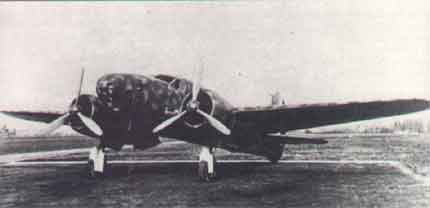 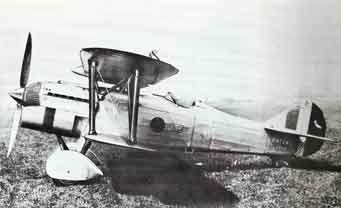
Caproni Ca.310B Fiat CR.32
Thirty-five minutes later, at 10:00, after refuelling the Gladiators, Dean (Gladiator L9046) and Woodward (Gladiator N5783) were off again, followed a few minutes later by Sergeant J. Craig (Gladiator N5768). Near Fort Capuzzo they intercepted two Caproni Ca.310Bs escorted by CR.32s. Dean shot down one of the CR.32s while Woodward and Craig jointly attacked one Caproni, setting one of the engines on fire. The Italian bomber crash-landed among British tanks near Fort Capuzzo. Woodward also attacked and claimed a second CR.32 (this claim is unconfirmed and no more Italian losses has been possible to verify) before retuning to base with a single bullet hole in one of the wings. Dean later told:
"Soon after being promoted to Flying Officer, I was posted to No 33 Squadron at Mersa Matruh. I had a good flight with Verne Woodward, Peter Wickham and Sergeant Craig. It wasn't long after Italy declared war that we were moved to Sidi Barrani. We had no warning system at all of aircraft movement by the enemy, and only very sketchy and vague locations of both ours and their positions from the Army. We carried out the old traditions of patrolling along and over the border in the beginning in "vics" and pairs. Later, we flew bigger sweeps with more aircraft. The combat of 14 June near Fort Capuzzo was our very first encounter with the enemy. An inoffensive-looking light bomber was seen, and I detached Woodward and Sergeant Craig to attack, whilst I stayed aloft to cover. Within a short spell, I saw six aircraft in line astern heading from the west. I recognised them as CR 32s. I remember being quite calm, and wondering what the heck to do. I flew towards them, keeping them well to my right - with the thought of getting behind them (and shooting them down one by one - silly boy!).
Before I got close enough to them, they split in all directions and formed a ring around me - the sitting duck! I remembered somewhere about flying extraordinarily badly to present a very bad target. I throttled back, yawed and waffled up and down and around, and could hear the thump of their half-inch cannon at each pass, and as each came into my sights having a rapid squirt at them. This seemed to go on for ages, and eventually one of them dropped away and suddenly the remainder disappeared, and I was thankfully alone in the sky and flew back.
I heard upon my return to base that one CR 32 had been destroyed, apparently by me, whilst Woodward and Craig had shared the bomber. I did hear later that the pilot of the CR 32 had been struck by a single bullet through the heart."
They had clashed with six CR.32s from the 8o Gruppo flown by Capitano Martino Zannier (CO 92a Squadriglia), Tenente Ranieri Piccolomini (92a Squadriglia), Tenente Gioacchino Bissoli (93a Squadriglia), Sergente Ernesto Pavan (92a Squadriglia), Sergente Edoardo Azzarone (92a Squadriglia) and Sergente Roberto Lendaro (93a Squadriglia), which had been escorting three Caproni Ca.310s of the 159a Squadriglia, 12o Gruppo, 50o Stormo that had taken of at 09:30 to attack British armoured cars that were surrounding Amseat (Fort Capuzzo). The Italian fighters reported that they had chased seven (or nine) Gladiators and three of them were claimed shot down by Piccolomini, Pavan and Azzarone before Azzarone was shot down and killed (probably by Dean) over the British lines (according to some sources the Italian fighters only claimed two victories; one by Piccolomini and the second shared between Pavan and Azzarone). The Caproni shot down was flown by Sergente Maggiore Stefano Garrisi who parachuted together with Primo Aviere Montatore Alfio Ubaldi while gunner Aviere Scelto Armiere Giuseppe Pascali jumped too low and was killed (his body was recovered near Amseat on 26 December 1940). 130 rounds hit the Caproni of Tenente Mario Virgilio Corda and Sergente Maggiore Giovanbattista Trevisan was wounded. This was the second mission during the war for the 12o Gruppo and it revealed the unreliability of Ca.310s in this role. Breda Ba.65s soon replaced them.
At 06:00 on 29 June 1940, three CR.32s of the 160a Squadriglia took off for Ponticelli and from there at 11:15, a couple of them took off to operate in the Sollum-Sidi Omar area.
At 12:15, they were intercepted by an unrecorded number of Gladiators which quickly shot down the plane of Sottotenente Antonino Weiss, Adjutant of the 12o Gruppo. The pilot, wounded, made a forced landing near the "Litoranea" road, west of Bardia.
It seems that the CR.32s had clashed with 33 Squadron. At 04:55, in the first light of the morning, six Gladiators from 33 Squadron's 'B' Flight flew to Sidi Barrani for patrols covering Mersa Matruh and during the day, several sorties (at least three) were flown.
At 11:00, three Gladiators flown by Flying Officer Ernest Dean (Gladiator L9046), Sergeant J. Craig (N5783) and Pilot Officer Peter Wickham (K8031) took off. These were followed by two more flown by Pilot Officer Woodward (N5774) and Pilot Officer Henry Harrison (a 112 Squadron pilot on attachment to 33 Squadron) (N5768), which took off at 11:40.
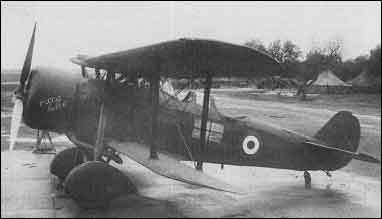
IMAM Ro.37 Reconnaissance Aircraft
At 12:30, enemy aircraft was intercepted and a Ro.37 was forced to land three miles west of Sidi Aziez after being attacked by Pilot Officer Wickham. The rear gunner was apparently hit and the aircraft landed in enemy territory.
Three CR.32s were encountered at 12:40 by one formation of three Gladiators in the Ridotta Capuzzo area. A dogfight ensued and Pilot Officer Woodward forced one of the aircraft down 2-3 miles north of Fort Capuzzo, near the road between Capuzzo and Bardia. He then pursued another aircraft of the enemy formation, which he shot down after a long dogfight. Both aircraft were shot down over territory occupied by the enemy.
During this patrol, Pilot Officer Harrison claimed a damaged CR.32 in the Capuzzo-Sidi Aziez area.
The 33 Squadron pilots seem to have been spilt up and Craig landed at 12:30, Dean at 13:15 and the three other pilots at 13:20.
The IMAM Ro.37bis claimed by Wickham probably belonged to 64o or 73o Gruppi Osservazione Aerea. It is possible that this claim in fact relate to the combat Wickham was involved in the next day (30 June 1940). Wickham also claimed an additional CR.32 during the day.
Woodward's claim seems to have been Sottotenente Weiss.
Totally, it seems that 33 Squadron claimed three or four victories during the day while in fact the Italian losses seem to have been one CR.32 (Sottotenente Weiss).
During 16 to 23 July 1940, Woodward and four other pilots from 33 Squadron were detached to 80 Squadron.
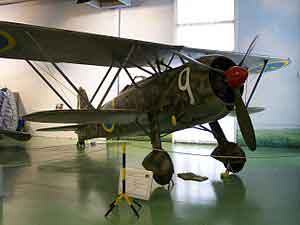
Fiat CR.42 Falco
At 16:00 on 24 July 1940, a formation of eleven CR.42s from the 10o Gruppo, backed by six more from the 13o Gruppo took off to patrol the Bir el Gobi - Sidi Omar - Sollum - Bardia area. Leading the 10o Gruppo formation was Maggiore Carlo Romagnoli (using an aircraft from the 91a Squadriglia) and with him were Tenente Franco Lucchini, Maresciallo Omero Alesi and Tenente Giovanni Guiducci of the 90a Squadriglia, Capitano Luigi Monti, Capitano Aldo Lanfranco, Tenente Vincenzo Vanni and Tenente Giuseppe Aurili of the 84a Squadriglia, Tenente Enzo Martissa, Sergente Maggiore Lorenzo Migliorato and Sergente Luigi Ferrario of the 91a Squadriglia. Pilots from the 13o Gruppo were Tenente Giulio Torresi, Tenente Eduardo Sorvillo and Sergente Maggiore Ernesto Scalet of the 77a Squadriglia, Sergente Francesco Nanin of the 82a Squadriglia and Capitano Giuseppe Dall'Aglio with Sottotenente Dario Magnabosco of the 78a Squadriglia.
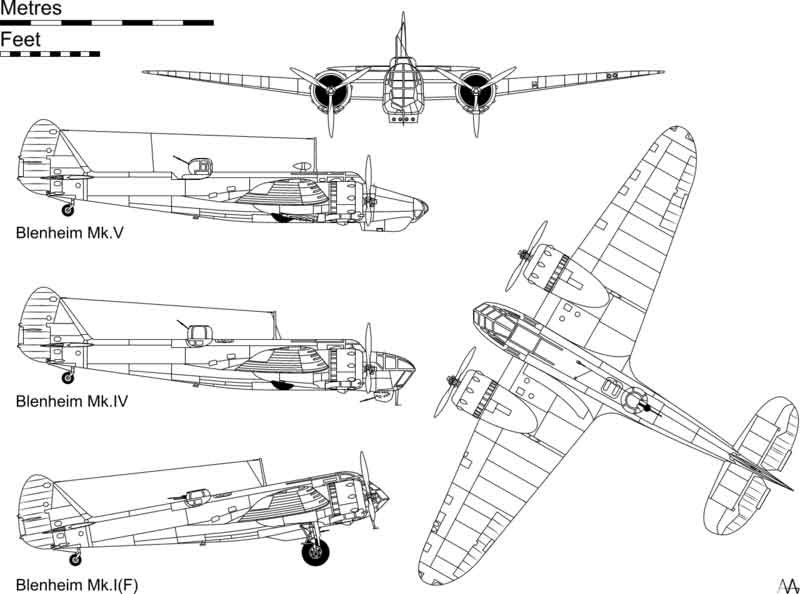
Bristol Blenheim
During the patrol they met a British formation estimated to nine Blenheims, which was attacking Bardia, escorted by 15 Gladiators. The CR.42s attacked the bombers and were in turn attacked by the British escort. Tenente Lucchini was the first to enter combat and damaged three of the British bombers by using 510 rounds of ammunition while the others were dispersed. Tenente Guiducci claimed a Gladiator using 90 rounds of ammunition. The CR.42s of the 84a Squadriglia remained manoeuvring in close formation until a 90a Squadriglia aircraft (Lucchini?) drove them against the enemies breaking their formation. Three aircraft from the Squadriglia returned to base one by one. Tenente Giuseppe Aurili met three Gladiators and damaged one. Capitano Lanfranco became isolated and, attacked by a reported three enemy fighters, was shot down and obliged to bale out in the Sidi Azeiz area. A British patrol took him prisoner a little later. Lanfranco was one of the oldest pilots of the 4o and a few days later a British message was thrown down near Tobruk, telling that he was wounded in Alexandria hospital. Tenente Martissa forced an enemy fighter to force-land then, coming back to base, saw his wingman in difficulties against the determined attack of an enemy fighter and, even with his guns jammed, attacked it, forcing the Gladiator to break away. Sergente Ferrario returned to base with a damaged fighter. According to some sources Tenente Lucchini is credited with an additional Gladiator during the day, but this can't be verified with the Squadriglie's Diaries.
Tenente Torresi claimed another Gladiator with 250 rounds of ammunition. No losses were suffered by the 13o Gruppo formation, which landed back at base between 17:25 and 18:05.
It seems that the Italian formation had been involved in combat with eight Blenheims from 55 Squadron tasked to attack targets in the Bardia area and five Gladiators from 'B' Flight of the 33 Squadron flown by Flying Officer Ernest Dean (Gladiator L9046), Pilot Officer Alfred Costello (N5776), Pilot Officer Woodward (N5768), Sergeant Ronald Slater (N5783) and Sergeant Shaw (N5775), which had taken off from Sidi Barrani at 17:40 and met a reported 18 CR.42s over Sollum at 18:30. In the combat Woodward claimed one of the enemy aircraft shot down and a second as a probable. Slater claimed a second CR.42 destroyed while Costello claimed a third. One more CR.42 was claimed by the other pilots and since Dean doesn't seems to have claimed anything during the day it is possible that this was claimed by Shaw but it haven't been possible to verify this. During the return flight Shaw was forced to land east of Buq-Buq with engine trouble probably caused by combat damage (probably the aircraft claimed by Martissa). Enemy bombing the day after destroyed his aircraft on the ground, although he rejoined his unit unharmed after a long walk across the desert. The other pilots from 33 Squadron landed back at base between 18:55 and 19:35.
Returning crews from 55 Squadron reported that after releasing their bomb load at 18:20, 'A' Flight was attacked by a single CR.42, which was part of a very open formation that didn't attack. The Italian biplane attacked from out of the sun, damaging slightly Blenheim L8667 flown by Sergeant Vignaux. The British bomber was hit by two bullets (one explosive), one in each mainplane. At 18:35, 'B' Flight was also attacked by a single CR.42. The attack was made from above and astern twice but none of the British aircraft were hit. It seems that one or both of these attacks were made by Tenente Lucchini.
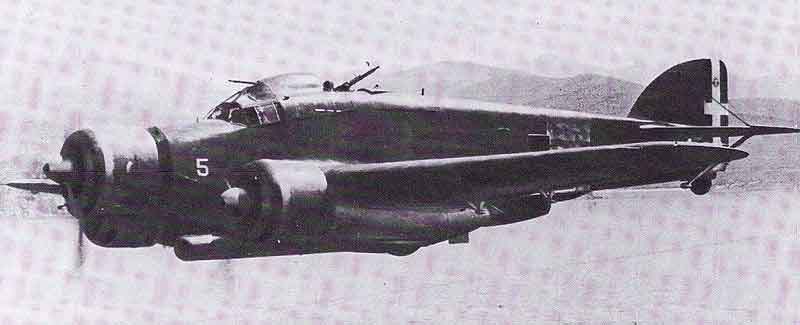
Savoia-Marchetti SM.79 Sparviero
At 09:15 on 25 July 1940, Derna El Ftàiah N1 suffered a heavy air attack, which destroyed two SM 79s on the ground and damaging two more heavily (RD). Five personnel were killed and thirteen more wounded. The personnel killed were Aviere Vincenzo Marinelli, Aviere Vincenzo De Fazio, Aviere Danilo Bartin, Aviere Nicola Fioravante and Aviere Paolo Fogliata who were part of the 30o Gruppo, 10o Stormo as were the destroyed SM 79s.
The attack was carried out by six Bristol Blenheims from 211 Squadron led by Flight Lieutenant Gordon-Finlayson. Originally nine bombers were to take part but two Blenheims didn't take off owing to engine troubles and one broke the tail wheel on landing at Sidi Barrani where a refuelling stop was provided. On the return journey L1482 flew by Pilot Officer Dundas lost its port airscrew and reduction gear and was forced to make an emergency landing at Fuka where the port undercarriage collapsed further damaging the plane.
33 Squadron was detailed to sweep the border area to cover eventual stragglers of 211 Squadron. Five Gladiators from the unit's 'B' Flight, flown by Flying Officer Ernest Dean (Gladiator L9046), Pilot Officer Alfred Costello (N5761), Pilot Officer Woodward (N5768), Sergeant Ronald Slater (N5783) and Sergeant Shaw (N5776) encountered a reported seven CR.42s over Bardia. Woodward and Slater each claimed one CR.42, of which Woodward's went down in flames before they shared a third. Slater was then seen spinning down, out of the fight, and Woodward became separated from the remaining Gladiators. He was attacked for seven or eight minutes at low level by several CR.42s before escaping. Costello claimed one shared CR.42 but who he claimed it with is unknown. A fifth CR.42 was also claimed in the combat by an unknown pilot. Dean didn't claim anything in this combat and whether Shaw claimed anything is unknown. Pilot Officer Woodward experienced a very hard combat, probably his hardest against Regia Aeronautica, and was very impressed by his opponents, in fact after this combat he once reflected:
"They were clean fighters, those Wops, and quite the equal of any Hun in the skill of combat flying."
A quite rare recognition from a RAF fighter pilot of the period.
As a curious note, the derogatory term "Wop" referred to an Italian born in the United States with the first immigrants, so it was well known to the Canadian Woodward. Its origin is not completely clear according with some sources it meant "Without Passport" according with others it was a corruption of the Neapolitan word "Guappo" (criminal boss).
It seems that the Gladiators had clashed with CR.42s from the 13o Gruppo. At 09:10, Sergente Maggiore Leone Basso of the 77a Squadriglia scrambled from El Adem following an air alarm. Tenente Giovanni Beduz of the 78a Squadriglia joined him ten minutes later. With them were also Sergente Rovero Abbarchi, Sottotenente Natale Cima and Sergente Ernesto Taddia (all of the 78a Squadriglia). The fighters were directed to an interception course along the probable return route of enemy bombers that had attacked Derna. While cruising over Bardia waiting for the enemy bombers, a formation of British fighters, identified just as "superior in numbers", attacked with height advantage. The Italian fighters (at least part of them because it is not sure that Natale Cima and Ernesto Taddia took part in the combat) turned the tables against their opponents. Sergente Maggiore Basso attacked a Gladiator, which was left smoking after using 250 rounds of ammunition while Sergente Abbarchi followed a Gladiator deep (40 km) inside the British territory and finally claimed it shot down. All the planes returned to base between 09:40 and 10:25.
Totally the 78a fighters had used 500 rounds of ammunition.
The ORB of 33 Squadron didn't report any losses after this combat. However, a team of 51 Repair and Salvage Unit moved to Sidi Barrani on 27 July 1940 to salvage the "crashed" Gladiators N5768 (Pilot Officer Woodward) and L9046 (Flight Lieutenant Dean) of 33 Squadron, which indicates that they at least suffered some severe damage confirming the Italian claims. L9046 was in fact so damaged that it had to be written off.
According to many post-war British sources Sergeant Slater was shot down in this in combat even if according to the 33 Squadron's ORB, he returned to base at 11:20 together with the other pilots and took part in another patrol with Pilot Officer Costello between 14:00 and 14:40 using Gladiator N5783 again. Some British studies suggested that it was in fact forced down but was able to take off later regaining his unit.
112 Squadron flew a patrol near Bardia during the day and spotted eight CR.42s. Flying Officer Peter Strahan of 'A' Flight claimed one shot down, although he himself was hit and forced to make an emergency landing on the return flight. He was returned to base with an infantry vehicle.
It is highly likely that 33 and 112 Squadrons made a combined operation over Bardia because on the Italian side, the combat of the three 13o Gruppo pilots is the only recorded combat. This could also explain the claim made by an unknown pilot (Flying Officer Strahan?) reported by 33 Squadron.
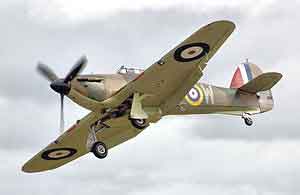
Hawker Hurricane M.1
He gained more success during December 1940, by which time the squadron had re-equipped with Hurricanes.
In the afternoon on 9 December 1940, SM 79s were out to bomb British troops at the Sidi Barrani - Bir Enba area. They were to be escorted by 19 CR.42s of the 9o Gruppo led by Maggiore Ernesto Botto, which had taken off from El Adem at 14:55. The fighters included seven from the 73a Squadriglia (Tenente Valerio De Campo (CO), Tenente Giulio Reiner, Sottotenente Alvaro Querci, Sergente Maggiore Guglielmo Biffani, Sergente Maggiore Enrico Dallari, Sergente Maggiore Antonio Valle and Sergente Santo Gino) seven from the 97a Squadriglia (Capitano Antonio Larsimont Pergameni (CO), Tenente Ezio Viglione Borghese, Sottotenente Riccardo Vaccari, Sergente Maggiore Otello Perotti, Sergente Maggiore Massimo Salvatore, Sergente Angelo Golino and Sergente Alcide Leoni) and four from the 96a Squadriglia (Tenente Aldo Gon and Sergente Giuseppe Tomasi together with two unknown pilots).
More Italian fighters were up to escort the bombers and at 15:10, Sergente Maggiore Fiorenzo Milella of the 366a, 151o Gruppo, attached to a formation of nine CR.42s of the 368a Squadriglia (Capitano Bruno Locatelli, Sergente Maggiore Davide Colauzzi, Sergente Ernesto De Bellis, Sottotenente Furio Lauri, Sergente Maggiore Annibale Ricotti, Tenente Orfeo Paroli, Sergente Piero Hosquet, Sergente Stefano Fiore, Sergente Ottorino Ambrosi) were out to escorted Italian bombers in the Bir Enba area.
The rendezvous with the bombers over A3 failed and after 20 minutes, the fighters of the 9o Gruppo arrived and together they proceeded towards the front on a free sweep. Three SM 79s were discovered and escorted for a while. Over Buq-Buq, a Hurricane strafing along the coastal road was discovered and the SM 79s were left to the 9o Gruppo while the CR.42s of the 151o Gruppo attacked the British fighter. The Hurricane was claimed shot down in flames and credited to the formation (but in fact only Locatelli, Lauri, Paroli and De Bellis fired their guns).
The 151a Gruppo fighters returned to base at 16:50.
Meanwhile the fighters from the 9o Gruppo continued and 30 km south of Bir Enba they spotted some Gladiators at a lower level and dived on them, but suddenly the CR.42s were jumped by a reported two Squadrons of Hurricanes or Spitfires, attacking respectively the 73a Squadriglia and the 96a Squadriglia with the 97a Squadriglia. A large dogfight started and after 20 minutes of combat many claims were submitted by the Italian pilots.
Tenente Vaccari fought alone against four Hurricanes, claiming one destroyed (as a Spitfire) and damaging the others before his Fiat was hit in the fuel tank and in the engine. He crash-landed near Sollum, the aircraft turning over and caught fire; he was burned in the face and hands. Sergente Maggiore Salvatore claimed a Spitfire and several damaged before being wounded in his left arm. He managed however to return to base. Sergente Golino was hit in his back, but managed to claim his attacker before being compelled to evade and land at Amseat A3. Sergente Maggiore Biffani (Fiat CR.42 MM5599/73-9) claimed a Hurricane but was at the same shot down by his victim and was captured. He recalled:
"In the afternoon of 9 December 1940 we were flying between Mersa Matruh and Buq-Buq, when my wingman, Sottotenente Alvaro Querci, warned me that we had enemies behind us. I alerted Botto by shooting a burst [Note that the CR.42 had no radio during this period], then I realized they were near my tail, so I made a 180-degree turn and I saw them pass: they were three Hurricanes. I climbed almost vertically and saw the 73a Squadriglia in front, the three Hurricanes behind it and 96a and 97a Squadriglia behind them, all in a vertical line that went down to the ground. Then I discovered a Hurricane that was breaking off from the combat, clearly he had seen the other Italian fighters on its tail. I continued to climb, now I was the highest fighter of them all, then I dived down at full throttle [towards the escaping Hurricane]. I arrived near it and then I reduced speed and put the revolutions between 1850 and 2250 because otherwise I would had cut my propeller as happened to Gon and others, because the airscrew went out of gear and the round was fired when it passed in front of the gun (...). When I closed to it, I opened fire. I aimed and saw the explosive bullets that exploded on the wing. Why didn't anything happen? Was there no fuel at all? I fired at the other wing but it was the same, the bullets exploded but nothing happened. I fired into the engine, nothing happened. I saw the tracers very well, and after all, it wasn't the first time I was shooting. At Gorizia I used to hit the target balloon with ten rounds only. In the meantime, I was losing speed and falling behind, O.K. Goodbye! It passed and turned towards me again - so I hadn't caused any damage to it - and I did the same. We found ourselves face to face at a distance of around 500-600 metres. I started firing and saw my tracers hitting it, then its wings lit up and in the same moment my plane caught fire, it was just an instant. My plane was severely damaged and while I was trying to land I saw the Hurricane that dived into the ground and exploded. I saw no parachute. I force-landed among British MTs and was immediately taken prisoner. I went back home after 63 months of POW!"
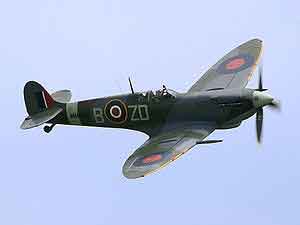
Supermarine Spitfire LF Mk.9
Additional Hurricanes were claimed by Botto, Sergente Dallari, Sergente Valle and an unknown pilot of the 73a Squadriglia (it is possible that this was a shared claim). It seems possible that also Sergente Maggiore Perotti claimed a victory (this claim is disallowed in the 97a Squadriglia diary, who only credits him with some Spitfires damaged).
Sergente Gino claimed a probable before his aircraft was badly damaged and he made an emergency landing near the frontline. Additional probables were claimed by Sottotenente De Campo and Reiner. Sergente Alcide Leoni together with other pilots claimed several damaged fighters. Capitano Larsimont Pergameni was attacked but was able to evade without claiming any hits on any enemy aircraft. Tenente Viglione was soon hit by a Hurricane, but manoeuvred to shoot at and damage it; however he was hit again in the engine by another enemy fighter, so he had to made an emergency landing near Buq-Buq.
Totally the Italian pilots claimed seven shot down (Biffani's claim was not initially credited since he was taken POW) and three probables (it's possible that some of the probables were claimed as shared). The Gruppo's Diary reduced these claims to four confirmed and three probables.
Totally during the combat one Fiat was shot down (Biffani POW) and three CR.42s carried out emergency landings (Viglione, Vaccari and Gino). Three pilots were wounded; Vaccari, Golino and Salvatore. Both Reiner's and Valle's aircraft returned lightly damaged while Tenente Aldo Gon and Sergente Giuseppe Tomasi landed at Amseat due to lack of fuel.
It seems that they had clashed with fighter from at least two RAF Squadrons. 12 Hurricanes from 33 Squadron had taken off with 10 minutes intervals to ground strafe the enemy's rear areas, concentrating on troops and motor transports. They reportedly caused much damage before they were intercepted by three formations of CR.42s. During the day, 33 Squadron's pilots claimed three Italian fighters and reported another going down out of control. One of the Squadron's Hurricanes had to force-land but the pilot was saved (this was probably claimed by the 151o Gruppo pilots). Considering that one of the claims should relate to the loss of Sergente Francesco Nanin in the morning then the other two are probably connected with this specific engagement. It is also known that Flying Officer Woodward shot down two of the Fiats claimed by his unit, one of them in flames, and damaged a third.
The second Squadron was five Hurricanes (Squadron Leader Patrick Dunn (P3723), Flight Lieutenant John Lapsley (V7293), Flying Officer Thomas Patterson (P3720), Flight Lieutenant Peter Wykeham-Barnes (V7300) and Pilot Officer Ernest 'Imshi' Mason (P3722)) from 274 Squadron, which had taken off at 15:00. They were flying in two vics at 15,000 feet when they spotted 27 CR.42s in tight vics (four main formations of 8, 7, 6 and 6 aircraft) over the Sidi Barrani-Sofafi area at 16:08. The Italian fighters were discovered at 9 o'clock, 10-12 miles away and stepped so that they were slightly above and 2000 feet below. The RAF pilots succeeded in approaching unobserved and then delivered a multiple direction attack followed by a general dogfight. The Hurricane pilots reporting five confirmed victories and three probables for one Hurricane damaged. In the unit's ORBs Form 541 victories were claimed by Flight Lieutenant Wykeham-Barnes (plus one probable), Squadron Leader Dunn (plus two probables), Flying Officer Patterson, Flight Lieutenant Lapsley and Pilot Officer Mason. However, in the unit's ORB Form 540, the number of confirmed victories raises to six with three more CR 42s severely damaged; the identity of the claimant of this last victory, however remained unknown even if the CFRs of the action would suggest Squadron Leader Dunn.
Squadron Leader Dunn (he delivered an aster attack) reported:
"The enemy engaged in dogfight. Claim one E a/c for certain (saw it hit the ground). Attacked two in tight vic and was at 200 yards point blank range and fell certain must have killed pilots. Got another good and point blank deflection shot at another. Closed from optimum to point blank range at first. Must (?) have shot down the first two but could not spare time to confirm. 3rd point blank deflection shot likely and fourth adversary saw it hit the ground (claim 1 confirmed and 2 others which I feel certain about but must go down as unconfirmed)."
Flight Lieutenant Lapsley (he delivered a head-on attack) reported:
"The enemy fired back. 1 CR 42 shot down and seen to hit the ground without burning. Several other machines were shot at individually. They can out manoeuvre a Hurricane but one can get away and then come back."
Pilot Officer Mason (he was discovered during the approach and had to dogfight from the beginning) reported:
"The enemy tried to turn inside me. 1 CR 42 shot at short range from above into cockpit. Aircraft turned (unreadable) with sparks from it. Followed it down until attacked by others CR 42s. Using 15o flap climb (unreadable) but not quite equal to 42. Speed on level far superior. Possible when attacked from above to turn and deliver short head on burst."
Flight Lieutenant Wykeham-Barnes reported:
"The enemy dog fought, during dogfight damaged two enemy and sent one down out of control but could not see it crash as another was in my tail. The enemy fairly aggressive."
Flying Officer Patterson (he delivered a quarter attack from port side) reported:
"The enemy started a general dogfight. 1 CR 42 shot down and seen to burn out on the ground".
The 274 Squadron Hurricanes all had landed at 17:00.
It is also highly likely that 112 Squadron's Gladiators were present. They were up, patrolling the Bir Enba area, and were noted and attacked by 9o Gruppo's pilots. The Squadron flew at least two patrols during the day but the unit's ORB don't report any engagement.
The escorted bombers were three SM 79s of the 29o Gruppo (one of 11a Squadriglia and two of 63a Squadriglia) commanded by Colonnello Mario Aramu that attacked at around 16:40 while the RAF fighters were busy with the CR.42s of 9o Gruppo. Aramu noted the combat between Italian and Commonwealth fighters and claimed an effective bombing from 3000 metres coming back at Gambut at 17:50 while the other formation were four SM 79s of the 6a Squadriglia, 44o Gruppo, commanded by Maggiore Andrea Bosi who had taken off at 14:25 from Tmini M2. Before the mission Bosi had received order not to press home his attack (but to turn back) in case he failed the rendezvous with the escorting fighters over Sollum, so when the rendezvous with the escort failed he turned back and landed at Tmini M2 at 16:40. His were the bombers that were discovered by 9o Gruppo flying back towards Libya.
On 19 December 1940, the 9o Gruppo flew its last mission before retirement from North Africa. Taking off from Ain El Gazala T4 at 15:00, Capitano Antonio Larsimont Pergameni led ten other aircraft from the 73a Squadriglia (Tenente Pietro Bonfatti, Sottotenente Giuseppe Oblach, Sergente Mario Guerci and Sergente Pasquale Rossi), 96a Squadriglia (Sergente Maggiore Dante Labanti, Sergente Maggiore Giovanni Gallerani and an unknown pilot) and 97a Squadriglia (Ezio Viglione Borghese, Sergente Maggiore Raffaello Novelli and Sergente Alcide Leoni) to an escort mission together with 14 CR.42s of the 10o Gruppo. These had taken off from the Z1 landing ground (ten kilometres south-east of T4 on the opposite side of the "litoranea" road) where they had transferred the same morning. The 10o Gruppo pilots were led by Maggiore Carlo Romagnoli and included five fighters from the 91a Squadriglia (Sottotenente Andrea Dalla Pasqua, Sergente Maggiore Leonardo Ferrulli, Sergente Maggiore Lorenzo Migliorato, Sergente Maggiore Natale Fiorito and Sergente Maggiore Giovanni Casero), six from the 90a Squadriglia (Tenente Giovanni Guiducci, Tenente Franco Lucchini, Sergente Luigi Contarini, Sergente Bruno Bortoletti, Sergente Alfredo Sclavo and Sergente Giovanni Battista Ceoletta) and two from the 84a Squadriglia (Sergente Domenico Santonocito and Sergente Piero Buttazzi).
They escorted twelve SM 79s of the 41o Stormo, which took off at 14:45 from Martuba M2 with Tenente Colonnello Draghelli and Tenente Colonnello d'Ippolito at their head. They were to attack Sollum harbour and then to proceed to attack vehicles 10 km off Ridotta Capuzzo aimed against the British supply system.
Some minutes after 15:45, above the Sollum area, they were surprised by a number of Hurricanes; Tenente Guiducci reported five of them, the 73a Squadriglia recorded the attack of about ten while some the 235a Squadriglia crews spoke of eight "Spitfires". It seems that the Hurricanes were somewhat lately intercepted by the CR.42s from 73a and 96a Squadriglie and 10o Gruppo while the 97a Squadriglia stayed with the bombers. According to Guiducci, the reaction of the CR.42s saved the bombers, avoiding the interception but this was not the case.
In the following combat, the Italian claims were extremely confused. Sergente Maggiore Ferrulli was credited with a Hurricane destroyed (in one of the rare individual victories assigned by his unit) and another damaged, but his aircraft was hit in the engine and he had to make an emergency landing near Bardia (he was unhurt and returned to his unit on 22 December). The 90a Squadriglia claimed two shared victories and two Hurricanes forced to flee with the use of 1328 rounds of ammo. The 84a Squadriglia claimed one individual and one probable victory shared with the whole 10o Gruppo. The 97a Squadriglia also claimed one Hurricane confirmed and one probable shared with the 10o Gruppo. The 73a Squadriglia claimed two shared individual and two probables. Post-war studies stated that one of the shared victories of 73a Squadriglia was in fact an individual of Tenente Bonfatti while Sergente Rossi got a damaged and Sottotenente Oblach one probable and one damaged. In fact, the Italian Bulletin of 20 December claimed that in a savage battle two Hurricanes were shot down in exchange for an Italian fighter that failed to return This suggests that all the Squadriglia Commanders at the end claimed the same two victories, from the original documents we can see that in fact one was an individual achievement of Ferrulli while the other was most probably a shared or possibly an individual of Bonfatti. The CR.42 reported as lost was obviously Ferrulli's.
Sergente Buttazzi had to land at T5 because of an engine breakdown, while a fighter from the 73a Squadriglia was heavily damaged. The Italian formation landed back at 17:05.
At least seven of the bombers were hit. Capitano Meille (CO of the 233a Squadriglia) and Sottotenente Bresciani were wounded and the co-pilot Sergente Maggiore Musiani was forced to make an emergency landing at Tobruk T5. The SM 79 of Sottotenente Trolla force-landed (and was most probably lost) after being hit by 543 bullets; Primo Avieri Luigi Favale was killed while Primo Avieri De Pasquale and Primo Avieri Palmieri were wounded. Tenente Stancanelli's (233a Squadriglia) aircraft received 162 hits and also made an emergency landing. Sergente Maggiore armiere Antonio Carta (part of Tenente Stancanelli's crew), in the confusion of combat, erroneously believed that his aircraft was falling out of control, jumped with his parachute and became MIA. Tenente Colonnello Draghelli made an emergency landing at Tobruk T2bis with his co-pilot Tenente Premurù, Maresciallo motorista Scagliarini, Sergente Maggiore armiere Della Ciana and Sergente RT Maurelli injured. In addition, the SM 79 of Tenente Persico, which was the last to land at 16:45, was damaged. The bomber's gunners spent about two thousand rounds of 7.7mm ammunition and five thousands of 12.7mm, claiming three British fighters and one probable.
They had been intercepted by Hurricanes from 274 and 33 Squadrons. The former unit was employed in patrols in the Sollum-Bardia-Gambut area. At 15:50, Flight Lieutenant John Lapsley (V7293) was alone but another Hurricane was in the vicinity when, at 11,000 feet over Sollum, he discovered a mixed formation of 18 SM 79s plus CR.42s 12 miles ahead and slightly to starboard. He attacked the escort that engaged him mainly head on. He reported:
"one CR 42 dived into the ground about 30 miles west of Sollum. Being a bit late arriving after the bombing I found it impossible to engage the S79 due to the attentions of the CR 42s, about 30 CR 42s in vics of three making vics of nine both sides of the bombers and 3000 feet above them. The main force carried on being attacked by Flying Officer Weller 274 Squadron."
As a special comment, he remarked: "Enemy attacked in a most determined manner."
Flying Officer Arthur Weller (V7300) reported being up with another Hurricane later engaged by CR.42s (obviously Lapsley) and possibly another behind him (33 Squadron aircraft?). He was flying at 18,000 feet over the Sollum - Bardia road at 15:45 when he discovered SM 79s with CR.42 escort. He saw the fighters wheeling towards him while the bombers didn't take any action. He reported:
"7 S79s fired at and damaged at least one engine on fire, one or two undercarriages fell out. Only noticed one formation of fighters to starboard of bombers [obviously Lapsley had drawn the attention of the rest of the escort] so attacked from port to line astern with plenty of extra speed. Took each sub leader in turn then his no 2. 7 aircraft altogether when work finished. Part of formation I had attacked was disorganized and impossible to see any missing. Owing to approach of CR 42s and no ammunition, I had to leave the fight. I noticed part of formation I had attacked to be in difficulties. Two a/c pulled up practically vertically and probably collided, impossible to see if any went down."
He didn't reported suffering damage of any kind but back at base his machine was found riddled with bullets. Weller was subsequently credited with one damaged SM 79.
33 Squadron also flew an offensive patrol over the Sollum-Gambut area where they met SM 79s and CR.42s and there is little doubt that they engaged this Italian formation. The British pilots claimed three SM 79s and four CR.42s. Two of the fighters falling to Flying Officer Woodward, who attacked and shot them down apparently without the knowledge of the other Italians and two to Flying Officer Charles Dyson (P2499). It is not known who claimed the bombers. Considering the high level of accuracy of 151o Gruppo's reports that recorded being attacked by six to seven British monoplanes earlier on the day it is possible that some of the claims of 33 Squadron (which also patrolled over the Gambut area) where in fact against them.
On 25 December 1940, the 23o Gruppo flew its first escorting missions after its arrival in the theatre, one of these was at 15:00 with 12 CR.42s in collaboration with 22 CR.42s from the 10o Gruppo, which had taken off at 14:35 to escort the 15o Stormo's SM 79s bound to attack Sollum Harbour.
The fighters from the 23o included four from the 70a Squadriglia (Maggiore Tito Falconi, Tenente Claudio Solaro, Sottotenente Oscar Abello and Sergente Maggiore Balilla Albani), four from the 74a Squadriglia (Capitano Guido Bobba, Tenente Mario Pinna, Tenente Lorenzo Lorenzoni and Sergente Emilio Stefani) and four from the 75a Squadriglia (Tenente Pietro Calistri, Tenente Ezio Maria Monti, Sottotenente Giuseppe De Angelis and Maresciallo Giovanni Carmello). The fighters from the 10o Gruppo included six CR.42s from the 91a Squadriglia (Maggiore Carlo Romagnoli, Capitano Vincenzo Vanni, Sottotenente Ruggero Caporali, Sottotenente Andrea Dalla Pasqua, Sergente Maggiore Leonardo Ferrulli and Sergente Maggiore Lorenzo Migliorato), seven from the 90a Squadriglia (Tenente Giovanni Guiducci, Tenente Franco Lucchini, Sottotenente Alessandro Rusconi, Sottotenente Neri De Benedetti, Sergente Alfredo Sclavo, Sergente Luigi Bagato and Sergente Enrico Botti) and nine from the 84a Squadriglia (Capitano Luigi Monti, Tenente Antonio Angeloni, Sergente Maggiore Salvatore Mechelli, Sergente Domenico Santonocito, Sergente Luciano Perdoni, Sergente Corrado Patrizi, Sergente Piero Buttazzi, Sergente Mario Veronesi and Capitano Mario Pluda (91a Squadriglia)).
The formation was attacked by some Hurricanes that were counter-attacked and obliged to flee. Two Hurricanes were claimed as probably shot down by the pilots of 90a and 91a Squadriglie (the 90a Squadriglia used 160 rounds of ammunition), which claimed them as shared with the 23o Gruppo even if the pilot from the 23o Gruppo in fact weren't able to claim anything. Tenente Guiducci landed at T5 with engine trouble while the rest of the formation landed at Z1 between 16:50 and 17:00. No losses were suffered by the bombers, which claimed to have hit an aircraft carrier. In fact, they aimed their bomb load at a monitor, but it is not known if the ship was in fact hit.
The Hurricanes were probably machines of 33 Squadron with Flying Officer Peter Wickham and Flying Officer Woodward that encountered one SM 79 and one CR.42, damaging the CR.42. The action was however recorded in the morning.
The last Italian bombing mission of the day on 27 December 1940 was again against Sollum. Four SM 79s from the 41o Stormo under Tenente Colonnello D'Ippolito and four bombers from the 216a Squadriglia, 34o Stormo, led by Tenente Romanini took off from Tmini at 14:30.
They were escorted by fighters from the 23o Gruppo and 10o Gruppi. Maggiore Tito Falconi was at the head of the formation of the first unit, which also included Tenente Claudio Solaro, Sottotenente Oscar Abello and Sergente Ubaldo Marziali from the 70a Squadriglia, Tenente Mario Pinna, Sottotenente Milano Pausi and Sergente Giuseppe Sanguettoli from the 74a Squadriglia and Tenente Pietro Calistri, Tenente Ezio Maria Monti, Maresciallo Giovanni Carmello, Sergente Leo Mannucci and Sottotenente Leopoldo Marangoni from the 75a Squadriglia.
It seems that the bomber formation split and the 41o Stormo attacked British mechanized units in Halfaya and Gabr Bu Fares under heavy AA that damaged, although slightly, all the aircraft. The SM 79s of the 34o Stormo attacked ships in Sollum harbour and were intercepted by many Hurricanes. The SM 79s were totally unable to defend themselves because of icing on all the guns and one of them was shot down. This was Sottotenente Aldo Peterlini's bomber and Peterlini was killed together with three of his crew (Sergente Maggiore Arturo Scagnetti (second pilot), Aviere Scelto Motorista Alcide Frizzera and Aviere Scelto Radiotelegrafista Gioacchino Scuderi). The other two members of the crew (Primo Aviere Armiere Ciancilla and Primo Aviere Montatore Fiore) where able to bale out. Tenente Pandolfi's aircraft was riddled by enemy bullets (probably RD) while the other two SM 79s were less seriously damaged although suffering some wounded among their crews.
They had been intercepted by 33 Squadron which claimed three SM 79s and one probable and probably two CR.42s during offensive patrols performed by pairs of Hurricanes over Sollum. They also claimed one SM 79 and one CR.42 damaged. Woodward claimed one of the probable CR.42s and the damaged CR.42.
Falconi's pilots recorded combat with many Hurricanes, one of which was claimed as probable by the 70a Squadriglia and six more were damaged. Tenente Solaro and Sottotenente Abello returned with damaged fighters. Solaro had been hit by AA fire and Sottotenente Abello by British fighters. Calistri and his men claimed a shared Hurricane and four more damaged. They landed back at 16:55. A shot down Hurricane was also recorded by the 74a Squadriglia, which also recorded a SM 79 shot down by AA fire.
The CR.42 escort from the 10o Gruppo was composed of seven fighters from the 90a Squadriglia (Tenente Giovanni Guiducci, Tenente Franco Lucchini, Sottotenente Alessandro Rusconi, Sottotenente Neri De Benedetti, Sergente Alfredo Sclavo, Sergente Bruno Bortoletti and Sergente Enrico Botti), six from the 84a Squadriglia (Capitano Luigi Monti, Tenente Antonio Angeloni, Sottotenente Bruno Devoto, Sergente Maggiore Salvatore Mechelli, Sergente Domenico Santonocito and Sergente Piero Buttazzi) and six from the 91a Squadriglia (Maggiore Carlo Romagnoli, Capitano Vincenzo Vanni, Sottotenente Andrea Dalla Pasqua, Sottotenente Orlando Mandolini, Sottotenente Ennio Grifoni and Sergente Elio Miotto). Tenente Guiducci reported that the heavy AA immediately hit one of the SM 79s, which was shot down. Then five monoplanes (Hurricanes and Spitfires(!)) tried to attack but were immediately counter attacked and one of them was shot down. Later, another attempt by a lone British fighter failed after the intervention of the Italian escort. The 90a Squadriglia pilots expanded 320 rounds of ammunition and it seems that in the end the victory was assigned to the whole formation as a Gruppo victory. It seems that it was the same aircraft claimed independently by the two Squadriglie of the 23o Gruppo.
On 28 December 1940, the Italian attacks on Sollum decreased. After the usual early morning raid by a 21a Squadriglia's machine piloted by Tenente De Angelis (taking off from T4 at 05:00 and returning 07:20), two machines of the 233a Squadriglia followed. They were intercepted by British fighters but disengaged thanks to the intervention of the CR.42s of the escort. It is possible that they had clashed with 33 Squadron. It is reported that 33 Squadron engaged a formation of eight SM 79s and seven CR.42s that was raiding Sollum. The squadron claimed one SM 79 and one CR.42. They also claimed four SM 79s and one CR.42 damaged. Woodward claimed a CR.42 shot down and two additional damaged SM 79s. One Hurricane was slightly damaged in this combat.
This mission is a minor mystery of the campaign because there are no recorded escort missions for the Italian fighter units for the day, with the 151o Gruppo out of action at Agedabia and the 23o Gruppo reportedly bogged down in mud at Derna until 31 December 1940. However, the presence of escort fighters was recorded by the Italian bombers and moreover a Hurricane was damaged so there is probably a gap in the Italian records.
His successes during this period were to bring him the award of a DFC, but this was not to be gazetted until 9 May 1941 by which time much else had transpired.
Late in February 1941 the squadron had begun moving to Greece and here further success was to come, particularly after the Germans entered the war here on 6 April 1941.
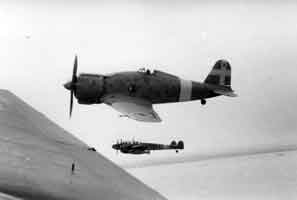 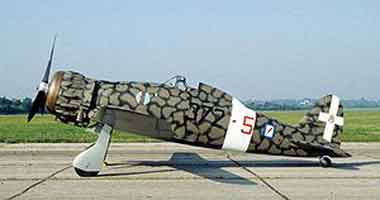
Fiat G.50 Freccia Macchi C.200 Saetta
Early in the afternoon on 23 March 1941 Squadron Leader 'Pat' Pattle was off at the head of ten Hurricanes from 33 Squadron, briefed to strafe Fier airfield, some miles west of Berat. As the fighters approached the target they were attacked by an estimated 20 G.50s and MC.200s, and a number of dogfights ensued, three G.50bis being claimed shot down, one each by Pattle, Flying Officer Holman and Flying Officer Woodward, who also claimed another damaged. Flying Officer Newton claimed a probable and a damaged also.
As a result the Hurricanes were scattered all over the sky, only Pattle and Woodward actually carrying out the strafe on the airfield, where the former claimed three aircraft destroyed. He then spotted a G.50bis at 200 feet, preparing to land, and gave this a burst. He saw it roll over, but did not witness it crash, so claimed only a probable.
On return he was extremely angry with his pilots for not carrying out the full strafe as briefed.
According to Italian records a G.50bis went up in flames on the ground but despite the claims made, there is no record of any Italian fighters having been shot down in combat on this occasion. Italian pilots of 154o Gruppo claimed one British fighter shot down and one probable, while similar claims were put in by the CR.42 pilots of 150o Gruppo. No RAF aircraft were lost.
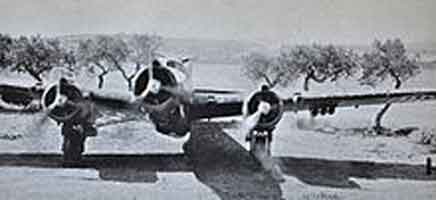
Cant Z.1007bis Alcione
At 12:55 on 2 April 1941 five Z.1007bis, three from 260a Squadriglia and two from 261a Squadriglia of the 106o Gruppo, 47o Stormo B.T., left Grottaglie to raid Volos. One turned back early with engine trouble, but the other four bombed their target at 14:50, dropping eight 250 kg and twelve 100 kg bombs from 22000 feet. Four Hurricanes of 33 Squadron and six Gladiators of 112 Squadron were scrambled on warning of their approach. Flight Lieutenant Littler and Flying Officer Sir James Kirkpatrick, Bart, in two of the Hurricanes, intercepted and claimed one bomber shot down, while Flying Officer Woodward, who had been delayed in taking off as his Hurricane was being re-armed at the time, pursued the bombers out towards the Gulf of Corinth. Even though only the four guns in the port wing had been loaded, he believed that he had shot down two of the bombers in flames on his first pass. Thinking that there had been four aircraft in the formation he was pursuing, he then attacked another of the bombers and the Cant flown by Tenente Mario Bozzi was hit, ditching in the sea off Missolonghi in the Gulf of Patras, where the crew were later rescued from their dinghy. During the initial attacks by the Hurricanes one Cant of 260a Squadriglia flown by Sottotenente Maurizio Morandini had been shot down directly over Almyros airfield (home of 11 Squadron), falling a few miles away; one man had baled out, coming down near the base and being captured. This was believed to have been the aircraft shot down by Littler and Kirkpatrick, but it may also have been attacked by Woodward.
After the second bomber had gone down, Woodward had continued to pursue the survivors, claiming that the last Z.1007bis attacked before his ammunition ran out was badly damaged. He recalled:
"I shot down three plus one probable from the "Green Mouse" squadron, supposedly commanded by Mussolini's son - he was believed to be the leader and the probable - I left him smoking and descending towards the western end of the Gulf of Corinth - I had no more ammunition."
It seems that wartime propaganda had made a good story out of this engagement, which Woodward had been led to believe. The "Green Mice" emblem was actually carried by S.79s of the 41o Gruppo B.T. not by any of the 47o Stormo units. Bruno Mussolini was indeed commanding officer of 260a Squadriglia, but on this occasion the formation had been led by Capitano Pier Luigi Braga. It would seem probable that Woodward had attacked Tenente Bozzi's aircraft twice, thinking that he had shot it down the first time and claiming it as a probable on the second occasion, when he possibly found it alone after it had fallen away from the other two aircraft, leading to the belief that there was only one survivor from the Italian formation.
In the end Woodward was credited with 2 destroyed and 1 probable.
On 6 April 1941 Germany declared war on Yugoslavia and Greece and immediately attacked.
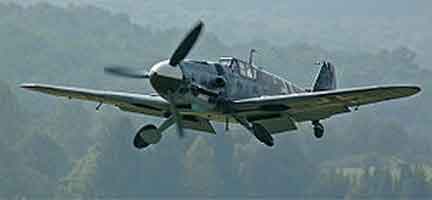
Messerschmitt Bf.109G-6
In the afternoon on 13 April 1941 Flying Officer Woodward carried out a lone reconnaissance to Bitolj and Vire. He was intercepted by three Bf 109s, one of which he claimed to have shot down, believing that he had seen the pilot bale out, and a second damaged. He then finished his reconnaissance and returned unscathed.
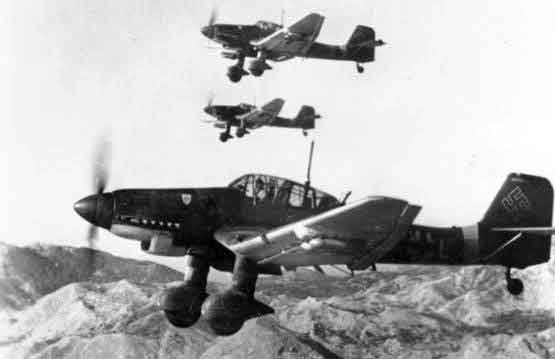
Junkers Ju.87D
In the afternoon on 14 April 1941 pairs of Hurricanes were despatched by 33 Squadron to patrol over troops in the Servia area who were under constant attack by Ju 87s. Flying Officers Woodward and Ernest Dean came across six of these as they were peeling off to attack motor transports, and three were claimed shot down with three others damaged, Woodward claiming two destroyed (one burning and the other spinning into the ground) and one damaged, and Dean the remainder.
Totally Allied fighters claimed five Ju 87s during the day and several Ju 87s were lost in the area. It seems that I/StG 3 lost Oberfeldwebel Rudolf Schnurawa and his gunner over Servia, while 9./StG 2 lost Oberleutnant Christian Banke and Feldwebel Georg Hoser in T6+KT south-west of Mount Olympus. A second 9 staffel aircraft was badly damaged and crash-landed on its return to Prilep-West. Oberfeldwebel Paul Lachmann and his gunner both were having been wounded. 2./StG, recently arrived from Libya, lost A5+EK to fighters near Trikkala (most probably shot down by PZL P.24 flown by Episminias (Sergeant) Argyropoulos of 22 Mira) with Fahnrich Walter Seeliger and Gefreiter Kurt Friedrich were taken prisoner.
On 15 April 1941 it was decided that 33 Squadron's remaining Hurricanes would join 30 and 80 Squadrons at Eleusis, while 112 Squadron's Gladiators would share Hassani with 208 Squadron.
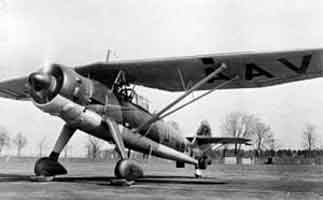
Henschel Hs.126 Reconnaissance aircraft
At 09:20 on 19 April 1941 seven 33 Squadron Hurricanes were led of by Squadron Leader 'Pat' Pattle to cover the Lamia area, where the army was still hard-pressed as it approached the end of its current withdrawal. Here a lone Hs126 from 1(H)/23 flown by Feldwebel Herman Wilhus (6K+AH) was seen. Although the slow reconnaissance aircraft was flying very low, Pattle led his section down onto its tail and fired a brief burst into it. His attack was followed by Flying Officer Woodward, and then by Flight Lieutenant Littler, after which the Henschel caught fire, tipped forward and crashed in flames into the forested hillside.
The Hurricanes regrouped and continued their patrol for another half an hour when an estimated nine Bf 109Es (actually five aircraft from III/JG 77) were encountered head-on.
Pattle's quick reactions allowed him to Immelmann out and come out on the tail of one Bf 109 at the extreme left of the German formation, and he reported that following his attack it went down in a glide, flipped over and crashed into the ground inverted. The sky was now full of dogfighting aircraft, but Pattle managed to get on the tail of another Bf 109 which he spotted flying low down in a valley towards Lamia. He believed that he had killed the pilot with his first burst, as this aircraft went into a dive and crashed. Meanwhile Flying Officer Woodward saw a Hurricane smoking. He tried to join it, but two Bf 109s intervened; one of these he shot down in flames. The crippled Hurricane with 25-year-old Flying Officer Frank Holman (RAF no. 40176) at the controls came down wheels down in swampy land near Megara and overturned, breaking the pilot's neck. Flying Officer Moir claimed a further Bf 109, whilst Flight Lieutenants Littler and A. B. Mitchell both claimed damage to others. In return Moir's aircraft was badly hit and he was forced down at Amphiklia, were P2643 was later destroyed as there were no spares available to repair it. Flight Lieutenant Mitchell's aircraft was also hard hit, but he was able to get back and force-landed at Eleusis.
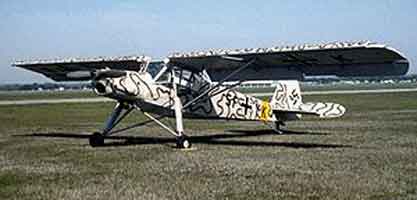
Fieseler Fi.156 Storch
Three Hurricanes were claimed shot down by the German pilots, one each by Oberleutnant Kurt Ubben, Unteroffizier Johann Pichler (according to other sources Feldwebel Heinrich Hackler of 8/JG 77) and Oberfeldwebel Erwin Riehl 25 km north-west of Lamia. However Ubben's Bf 109 was badly damaged and he force-landed in Allied lines, while the Staffelkapitän of 9/JG 77, Oberleutnant Armin Schmidt, was shot down and killed north-east of Lamia. A third Messerschmitt flown by Oberleutnant Werner Patz, was also hit and crash-landed at Larissa during the day, but there is no definite confirmation that he had been involved in the fight with 33 Squadron. Subsequently Stabsarzt Dr. Stormer of his Gruppe flew down in a Fieseler Storch and landed to pick up Ubben and fly him out; so sudden had been the combat that Ubben believed his aircraft had been hit by ground fire.
During the day on 20 April 1941 Eleusis was almost under constant attack but in the afternoon there was a pause in activity, which allowed a little time for the ground crews to bring the maximum possible number of Hurricanes up to readiness state. Squadron Leader 'Tap' Jones decided that if no further attack had developed by 18:00, all available Hurricanes would undertake an offensive sweep in an effort to raise morale amongst the civilian population of Athens and the surrounding areas, and as a boost to the defenders of Eleusis as well as to the pilots themselves.
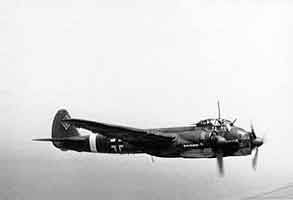 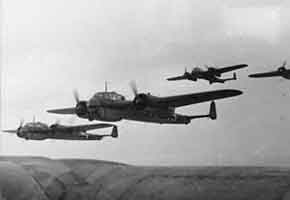 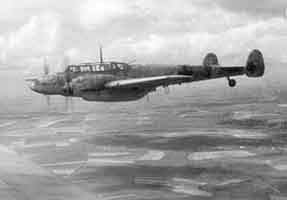
Junkers Ju.88 Dornier Do.17 Flying Pencil Messerschmitt Bf.110
However at about 16:45 a formation of 100 plus Ju 88s and Do 17s, escorted by Bf 109s and Bf 110s was reported approaching Athens. The Ju 88s (from I/LG 1) peeled off to make low-flying attacks on shipping at Piraeus, while individual Bf 110s of II/ZG 26 scoured the area, shooting up likely targets. One appeared over Eleusis just as the Hurricanes (nine of 33 Squadron and six of 80 Squadron) were preparing to take off. Fortunately, none were hit, and all took to the air individually, climbed to 20 000 feet and headed for Piraeus, forming sections of two or three en route.
The first trio to arrive over the port, flown by Flying Officers Peter Wickham, Flight Lieutenant Henry John Starrett (RAF no. 40188) and Percival 'Ping' Newton (a Rhodesian), caught 15 Ju 88s dive-bombing ships in the harbour (the Greek hospital ship Ellenis was sunk during the attack). The three Hurricanes followed them down and attacked as they pulled out of their dives; Wickham claimed one shot down, whilst Newton claimed two more. Just then Pilot Officer William Vale arrived on the scene, reporting seeing some 30 Ju 88s:
"I carried out eight attacks on the Ju 88s. One caught fire and started going down, so I left him and attacked another. Big chunks broke away from his wings and fuselage, and smoke poured from his engines. He went down vertically. I was then attacked by a 109, but I easily outmanoeuvred him, had a crack at some more, and came home when my ammo was exhausted."
One Ju 88 flown by Unteroffizier Helmut Benke (L1+ZH) was lost near Athens with all the crew; a second L1+UK, piloted by Oberfähnrich Werner Ziegler, was hit by a Hurricane's fire and the navigator Gefreiter Heinrich Baumgartner, received three bullets in the head and neck, dying almost at once. The gunners believed that they had shot down the attacking fighter, reporting seeing it fall into the sea near Kalamaki (it was probably the crash of Benke's Ju 88 they had seen or the explosions of bombs). A second Hurricane then attacked, putting the starboard engine out of action. This was also claimed hit by Gefreiter Hans Baumann (radio operator/air gunner) and was seen making for land. However the Ju 88 was rapidly losing height and although the crew threw out all removable equipment to reduce weight, it ditched in shallow water near Karies, at the foot of Mount Athos. The remaining members of the crew survived the crash. A third Ju 88 suffered engine trouble, but struggled back to Krumovo, where it crash-landed.
The Hurricane hit by Baumann was probably that flown by 'Harry' Starrett (V7804), which caught fire as a result. Starrett decided to fly back to Eleusis to attempt to save his aircraft. He made a hard wheels-up landing and the glycol tank blew up, enveloping the aircraft in flames. Starrett managed to get out, but had been very severely burned; he was rushed to hospital but died two days later.
Four more 80 Squadron Hurricanes now joined the battle, Flight Lieutenant William Woods leading Sergeant Charles Casbolt and Flight Sergeant Pierre Wintersdorff (a Frenchman) to attack a formation identified as Bf 110s, but probably composed of Do 17Z from I and III/KG 2, escorted by Bf 110s. Woods carried out two or three separate attacks, believing that he had probably shot down two (but only being credited with one) before breaking off to return to Eleusis to rearm. Wintersdorff claimed one aircraft shot down in flames, which he identified as an 'Fw187', but he was then attacked by a Bf 110 and wounded in one leg; his Hurricane was hard hit and he baled out into the sea from where he was soon rescued. Casbolt claimed two aircraft as Bf 110s, but was also then attacked from astern and had his rudder shot away. Breaking away, he encountered a Bf 109 which he reported he had shot down in flames.
Meanwhile the fourth pilot, Sergeant Edward Hewett found himself above six Bf 109s and later reported:
"I dived on the rear one, and he rolled on his back, and crashed to the ground with smoke pouring out. I made a similar attack on a second, and the pilot baled out. I had a go at a third, but didn't see what happened this time."
These Bf 109s were possibly from III/JG 77, two aircraft from this unit crash-landing, badly damaged. Three Do 17Zs also failed to return; U5+AL (Unteroffizier Helmut Reim), U5+HL (Leutnant Joachim Brüdern) and U5+AR (Oberleutnant Ludger Holtkampe) were all lost with their crews. Apparently Bf 109Es from 4./JG 27 were also involved in combat at this time, possibly with the 80 Squadron aircraft. Oberleutnant Rödel claimed three Hurricanes shot down in just over ten minutes 16:57, 17:01 and 17:08 (victories nos. 18-20), while Oberfelwebel Otto Schulz (victory no. 6) claimed another at 17:10. It seems that Flight Sergeant Leonard Cottingham of 33 Squadron also claimed a Do 17 in this combat.
At Eleusis the returning Hurricanes were being refuelled and rearmed as swiftly as possible, before climbing back into the fray. Squadron Leader Pattle was by now very ill with influenza, his temperature having been recorded as 103o. Nonetheless he took off for the third time of the day together with Flying Officer Woodward, following Flight Lieutenant William Woods, who was now off for the second time. Pattle and Woodward had not taken off before, as their aircraft had not been ready. Woodward recalled:
"I took off late with Squadron Leader Pattle - we climbed into a swarm of Ju 88s protected by masses of Messerschmitt 110s. We were overwhelmed. In sun I recall shooting down a 110 off Pattle's tail, in flames, then probably a Ju 88. Shortly afterwards Pattle got a confirmed Ju 88 (or Bf 110). Subsequently I lost contact with him, then damaged three more 110s, then, being out of ammunition returned tentatively to Eleusis. It was all over - for that day."
Ahead of Woodward, Pattle was seen going to aid of the Hurricane flown by Flight Lieutenant Woods, which was being attacked by a Bf 110. He opened fire at this aircraft and it was seen to burst into flames (presumably the aircraft Woodward had seem him to destroy), just as Woods' Hurricane also caught fire and dived into Eleusis bay, killing him. Two more Bf 110s latched onto the tail of Pattle's AS988, and it quickly began to blaze - there was an explosion, and the wreckage fell into the sea. Flight Lieutenant George Kettlewell arrived on the scene just in time to see the demise of his gallant leader and attacked one of the two Bf 110s responsible, shooting this down into the Bay also. He claimed a second Bf 110 before he too was attacked by yet another Bf 110, and was forced to bale out when V7807 was badly hit. A large and solid man, he landed heavily, cracking two vertebrae in his spine and spending several months in a plaster cast as a result.
Yet another Hurricane was falling to the Bf 110s at this time; Flight Sergeant Leonard Cottingham had claimed three Bf 110s in flames, but he was hit by a fourth and wounded, baling out of his stricken aircraft. The pilots of II/ZG 26's 5 staffel, led by Hauptmann Theodor Rossiwall, claimed five Hurricanes shot down in this engagement, one each by Rossiwall himself (victory no. 12), Oberleutnant Sophus Baggoe (victory no. 14), Oberfeldwebel Hermann Schönthier, Unteroffizier Fritz Muller and Oberfeldwebel Theodor Pietschmann. However two of the Gruppe's aircraft were lost in return - 3U+EN (Oberleutnant Kurt Specka) and 3U+FN (Feldwebel Georg Leinfelder), while a third crash-landed with severe damage.
Late in April, he was ordered to Egypt aboard a Sunderland to bring back a reinforcement Hurricane. He rejoined the unit, now in Crete, in mid-May, when he became a flight commander, but retreated on foot across the island after the German invasion, being evacuated on a destroyer later in the month.
On 9 May, he was decorated with the DFC.
On 11 May Squadron Leader E. A. Howell took command of 33 Squadron at Maleme when he arrived in a 230 Squadron Sunderland in Suda Bay. The majority of the unit's pilots were now about to leave, as it was intended that more replacements would soon fly in with new Hurricanes. Of the originals, only Flying Officer Woodward and Pilot Officer Dunscombe would remain, together with the ex-1430 Flight pilot, Flight Lieutenant A. B. Mitchell.
The seven 33 Squadron pilots left the next day in the same Sunderland, which had brought in the new commanding officer.
Woodward was promoted to Flight Lieutenant on 12 May.
On 15 May Flight Lieutenant Woodward was at readiness at Maleme when an estimated nine Bf 109s attacked the airfield, shooting up dispersed aircraft and gun positions, while a second Staffel circled above at 3-4000 feet, and another at 10,000 feet as top cover. Woodward recalled:
"I started my aircraft and seconds later whilst commencing to taxi the engine stopped and burst into flames. I jumped out and dashed to a standby aircraft (partially u/s I recall). No time to fasten parachute or harness - again attempted to get airborne, but as I gained ground speed there were two 109s firing at me from 600-800 yards - I almost made it, but flames again, so up undercarriage and skid to a stop and exit very smartly to cover in a ditch off the edge of the airstrip. Frankly I'd had enough for one day - it had to be the most uncomfortable few minutes of my life - if there is such thing as a "guardian angel" - he was working overtime that day on my behalf!"
On 20 May the airborne invasion of Crete begun and Flight Lieutenant Woodward took command of a party from 33 Squadron, which joined the New Zealand troops in hunting the German paratroops.
After leading the party, they arrived at Suda Bay on 26 May. Woodward was informed that he would be flown out in a Sunderland that evening, and was told to stand by. At the last moment however, he was directed to take charge of a party of walking wounded and lead them to a rendezvous with the Australian destroyer HMAS Nizam in Suda Bay, which took them to Alexandria.
The squadron reformed in June and was quickly back in action, supporting the unsuccessful Operation 'Battleaxe', when a flight of seven experienced pilots from 33 Squadron led by Woodward was attached to 274 Squadron.
At 16:45 on 17 June, 204 Group ordered the despatch of a dozen Hurricanes to carry out ground strafing sorties along enemy lines of communication and to attack dumps, camps and M/T in the Sidi Omar area. Six of the aircraft were drawn from the 33 Squadron detachment led by Flight Lieutenant Woodward, and two from 229 Squadron detachment, plus one from 73 Squadron, with Flight Lieutenant Dudley Honor leading the 274 Squadron section. Shortly into the flight a large number of enemy aircraft were sighted - Ju 87s from II/StG2 and 239a Squadriglia, with escort provided by Bf 109s of 3/JG27 and G.50bis from 150a Squadriglia.
Three of the pilots managed to successfully engage the Stukas, of which 229 Squadron's Pilot Officer Douglas Edghill (Z4366) claimed two shot down (victories nos. 5 to 6 of a total of 7) and Pilot Officer R. R. Mitchell (Z4630) one, while Flying Officer D. T. Moir (W9298) of 33 Squadron also claimed one. At least one aircraft of II/StG2 was totally lost in which Leutnant Franz Lauberger and Unteroffizier Thomas Mantsch were killed.
Meanwhile, the other Hurricanes soon became embroiled in a series of dogfights with the escort, Flight Lieutenant Woodward (Z4377) shooting down the G.50bis flown by Tenente Serafino Molinari, who was killed, before he engaged and damaged a second. Sergeant Eric 'Jumbo' Genders (Z4174), also of 33 Squadron, claimed two more (victories nos. 6 to 7 of a total of 8). Gender's claims were initially claimed only as damaged but were later confirmed by the Army. Flight Lieutenant Honor (Z4614) claimed a Messerschmitt damaged and Lieutenant D. Dove SAAF (Z4175), who was attached to 33 Squadron, reported that he had shot down another, but four Hurricanes failed to return including one (Z4509) flown by 33 Squadron's Flying Officer Eric Woods, who was killed. The 274 Squadron section lost two pilots, Frenchman Sous-Lieutenant Robert Grasset (Z4510) and Pilot Officer Terrence Officer (Z4533), both of whom survived to be taken prisoner, Montpellier-born Grasset's aircraft crashing in the Hasbardia area of Tobruk. The fourth missing Hurricane (W9198) was flown by the sole 73 Squadron representative, Pilot Officer Bert Reynolds, though he returned next day and reported that he had been shot down by AA fire.
The Messerschmitt pilots returned reporting four victories north-east of Gambut. Unteroffizier Schmidt claiming two at 17:10 and 17:12 (this was Schmidt's victories nos. 5 to 6 and his last before being killed on 28 June 1941), Oberfähnrich Hans-Joachim Marseille claimed one at 17:15 (victory no. 12 of a total of 158) and Feldwebel Karl Mentnich claimed one at 17:20 (his first of a total of 7). The G.50bis pilots also submitted claims for three Hurricanes shot down, Sottotenente Agostino Celentano, Maresciallo Olindo Simionato and Sergente Maggiore Patriarca being the claimants.
This was 33 Squadron's first encounter with the enemy since Crete.
On 12 July 1941 Flight Lieutenant Woodward of 33 Squadron and Flying Officer Crockett of 30 Squadron were scrambled from Amriya and vectored on to a Ju 88 of 2(F)/123 at 26,000 feet. This aircraft then dived for the ground being chased by both Hurricanes, which caught it forty miles south-west of their base at ground level and shot it down.
On 11 September 1941, his tour ended and he was posted to Rhodesia to the Air Training Group there, to become an instructor at 20 SFTS, Cranbourne, near Salisbury from 18 October 1941 to 15 June 1942.
On 15 June 1942 he was posted to the Training Group HQ in Salisbury on Air Staff duties.
He was promoted to Squadron Leader on 2 July 1942.
On 1 January 1943 he returned to Egypt and command of 213 Squadron.
Whilst here a Bar to his DFC in respect of his Greek activities was finally awarded on 6 August 1943.
He left the unit on 27 August 1943.
After a long spell on defensive duties, he went to AHQ, Levant, attending a staff course at the Middle East Staff College at Haifa between 4 September 1943 and 16 December 1943.
On 16 December 1943, he was posted to HQ, Middle East, on staff duties, being promoted Wing Commander on 27 June 1944.
On 20 February 1945 he took command of the Mediterranean Middle East Communications Squadron which had been formed from 173 Squadron, flying various transport aircraft.
Woodward ended the war with 4 and 2 shared biplane victories and a total of 18 and 4 shared destroyed.
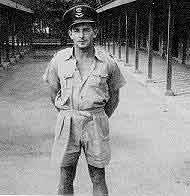 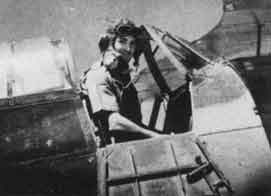
Right: Woodward in the cockpit of a Gladiator.
During the summer of 1945, he attended a Senior Commanders' Course on Malta, finally leaving the Comm. Squadron on 11 December 1946 to return to the UK. Here he was awarded an extended service commission as a Squadron Leader, then going to the Visual Interservice Training and Research Establishment as Chief Ground Instructor on 11 December 1946.
On 14 January 1947 he joined CFE as SAdO, and in July 1948 was awarded a Permanent Commission.
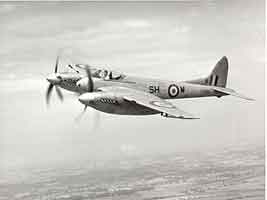
de Havilland Hornet
On 19 August 1948 he took command of 19 Squadron on Hornets, leading this unit until March 1950. He then attended the School of Land/Air Warfare at Old Sarum, before being posted to HQ, Fighter Command, on Staff duties from 25 September 1950.
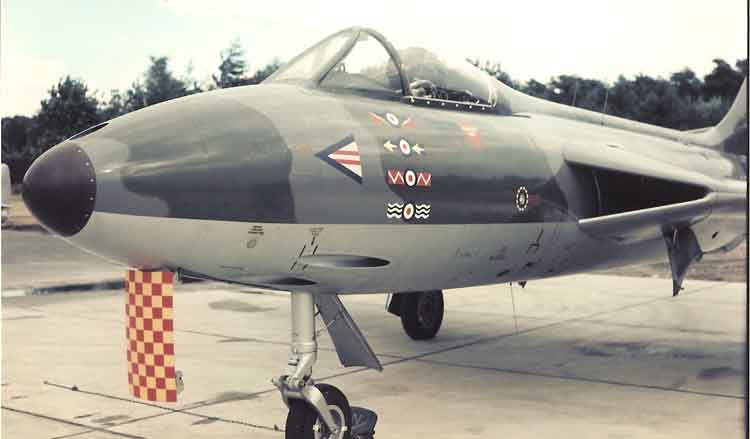
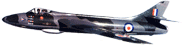
Hawker Hunter F.4 with OC 122 Wing pennant and 4 Hunter squadron badges
A spell at the Directorate of Personnel Services was followed by attendance at 3 AW Jet Squadron at Manby on 23 October 1955 and then 7 Course at the Flying College in 1956. After a few weeks practice at CFE, he went to Jever in 2nd TAF, Germany, as commanding officer, 122 Wing on 6 August 1956, flying Hawker Hunter jet fighters.
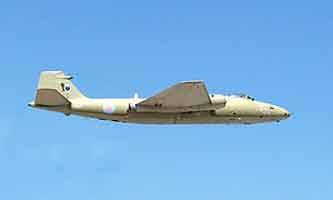
English Electric Canberra PR.9
Following a difference of opinion with a superior, he was moved to command 69 (PR) Squadron on Canberras at the start of 1958, moving with this unit from Germany to Malta in April, where in July 1958 it was renumbered 39 Squadron. He remained with this unit until 12 October 1959, when he went to the Ministry of Aviation, Controller of Aircraft, as SAdO.
He retired early from the service on 31 January 1963, and emigrated to Australia, where he formed an air charter company, which prospered.
In August 1967 he returned to his native British Columbia to set up a business there, but this failed and he was obliged to enter modest retirement as a member of the Corps of Commissionaires.
A biography Woody; a Fighter Pilot's Album was written by Hugh Halliday and published in 1987 (Canav Books).
Claims:
| Kill no. |
Date |
Time |
Number |
Type |
Result |
Plane type |
Serial no. |
Locality |
Unit |
|
1940 |
|
|
|
|
|
|
|
|
|
14/06/40 |
09:55-11:40 |
½ |
Ca.310(a) |
Shared destroyed |
GladiatorII |
N5783 |
near Fort Cappuzzo |
33 Squadron |
|
14/06/40 |
09:55-11:40 |
1 |
CR.32(b) |
Unconfirmed destroyed |
Gladiator II |
N5783 |
near Fort Cappuzzo |
33 Squadron |
| 1 |
29/06/40 |
12:40 |
1 |
CR.32(c) |
Destroyed |
Gladiator |
N5774 |
Riodotto-Cappuzzo area |
33 Squadron |
| 2 |
29/06/40 |
12:40 |
1 |
CR.32(c) |
Destroyed |
Gladiator |
N5774 |
Riodotto-Cappuzzo area |
33 Squadron |
| 3 |
24/07/40 |
18:30 |
1 |
CR.42(d) |
Destroyed |
Gladiator |
N5768 |
Sollum area |
33 Squadron |
|
24/07/40 |
18:30 |
1 |
CR.42(d) |
Unconfirmed destroyed |
Gladiator |
N5768 |
Sollum area |
33 Squadron |
| 4 |
25/07/40 |
10:10-11:20 |
1 |
CR.42(e) |
Destroyed |
Gladiator |
N5768 |
Bardia area |
33 Squadron |
|
25/07/40 |
10:10-11:20 |
½ |
CR.42(e) |
Shared destroyed |
Gladiator |
N5768 |
Bardia area |
33 Squadron |
| 5 |
09/12/40 |
p.m. |
1 |
CR.42(f) |
Destroyed |
Hurricane Mk.I |
|
Libyan frontier area |
33 Squadron |
| 6 |
09/12/40 |
p.m. |
1 |
CR.42(f) |
Destroyed |
Hurricane Mk.I |
|
Libyan frontier area |
33 Squadron |
|
09/12/40 |
p.m. |
1 |
CR.42(f) |
Damaged |
Hurricane Mk.I |
|
Libyan frontier area |
33 Squadron |
| 7 |
19/12/40 |
15:45 |
1 |
CR.42(g) |
Destroyed |
Hurricane Mk.I |
|
Sollum-Bardia |
33Squadron |
| 8 |
19/12/40 |
15:45 |
1 |
CR.42(g) |
Destroyed |
Hurricane Mk.I |
|
Sollum-Bardia |
33 Squadron |
|
25/12/40 |
morning |
½ |
CR.42(h) |
Shared damaged |
Hurricane |
|
Sollum area |
33 Squadron |
|
27/12/40 |
14:30- |
1 |
CR.42(i) |
Probable |
Hurricane Mk.I |
|
Sollum area |
33 Squadron |
|
27/12/40 |
14:30- |
1 |
CR.42(i) |
Damaged |
Hurricane Mk.I |
|
Sollum area |
33 Squadron |
| 9 |
28/12/40 |
|
1 |
CR.42(j) |
Destroyed |
Hurricane Mk.I |
|
Sollum area |
33 Squadron |
|
28/12/40 |
|
1 |
S.79(k) |
Damaged |
Hurricane Mk.I |
|
Sollum area |
33 Squadron |
|
28/12/40 |
|
1 |
S.79(k) |
Damaged |
Hurricane Mk.I |
|
Sollum area |
33 Squadron |
|
1941 |
|
|
|
|
|
|
|
|
| 10 |
23/03/41 |
p.m. |
1 |
G.50(l) |
Destroyed |
Hurricane Mk.I |
|
Fier, Albania |
33 Squadron |
|
23/03/41 |
p.m. |
1 |
G.50(l) |
Damaged |
Hurricane Mk.I |
|
Fier, Albania |
33 Squadron |
| 11 |
02/04/41 |
14:50 |
1 |
Z1007(m) |
Destroyed |
Hurricane Mk.I |
|
Gulf of Corinth |
33 Squadron |
| 12 |
02/04/41 |
14:50 |
1 |
Z1007(m) |
Destroyed |
Hurricane Mk.I |
|
Gulf of Corinth |
33 Squadron |
|
02/04/41 |
14:50 |
1 |
Z1007(m) |
Probable |
Hurricane Mk.I |
|
Gulf of Corinth |
33 Squadron |
| 13 |
13/04/41 |
p.m. |
1 |
Bf109E |
Destroyed |
Hurricane Mk.I |
|
Bitolj-Vire area |
33 Squadron |
|
13/04/41 |
p.m. |
1 |
Bf109E |
Damaged |
Hurricane Mk.I |
|
Bitolj-Vire area |
33 Squadron |
| 14 |
14/04/41 |
p.m. |
1 |
Ju87(n) |
Destroyed |
Hurricane Mk.I |
|
Servia area |
33 Squadron |
| 15 |
14/04/41 |
p.m. |
1 |
Ju87(n) |
Destroyed |
Hurricane Mk.I |
|
Servia area |
33 Squadron |
|
14/04/41 |
p.m. |
1 |
Ju87 |
Damaged |
Hurricane Mk.I |
|
Servia area |
33 Squadron |
|
19/04/41 |
09:20- |
1/3 |
Hs126(o) |
Shared destroyed |
Hurricane Mk.I |
|
Lamia area |
33 Squadron |
| 16 |
19/04/41 |
09:20- |
1 |
Bf109E(p) |
Destroyed |
Hurricane Mk.I |
|
Lamia area |
33 Squadron |
| 17 |
20/04/41 |
|
1 |
Bf110(q) |
Destroyed |
Hurricane Mk.I |
|
Piraeus harbour |
33 Squadron |
|
20/04/41 |
|
1 |
Bf110(q) |
Damaged |
Hurricane Mk.I |
|
Piraeus harbour |
33 Squadron |
|
20/04/41 |
|
1 |
Bf110(q) |
Damaged |
Hurricane Mk.I |
|
Piraeus harbour |
33 Squadron |
|
20/04/41 |
|
1 |
Bf110(q) |
Damaged |
Hurricane Mk.I |
|
Piraeus harbour |
33 Squadron |
|
20/04/41 |
|
1 |
Ju88(q) |
Probable |
Hurricane Mk.I |
|
Piraeus harbour |
33 Squadron |
| 18 |
17/06/41 |
16:45- |
1 |
G.50(r) |
Destroyed |
Hurricane Mk.I |
Z4377 |
near Sidi Omar |
33 Squadron |
|
17/06/41 |
16:45- |
1 |
G.50(r) |
Damaged |
Hurricane Mk.I |
Z4377 |
near Sidi Omar |
33 Squadron |
|
12/07/41 |
|
½ |
Ju88(s) |
Shared destroyed |
Hurricane Mk.I |
Z4268 |
40m SW Amriya |
33 Squadron |
Biplane victories: 4 and 2 shared destroyed, 2 unconfirmed destroyed.
TOTAL: 18 and 4 shared destroyed, 2 unconfirmed destroyed, 3 probables, 11 and 1 shared damaged.
Decode of letters in above table:
(a) Ca.310 of 159a Squadriglia, 12o Gruppo flown by Sergente Maggiore Stefano Garrisi, crash-landed. Garrisi and 1o Aviere Alfio Ubaldi parachuted while gunner Aviere Scelto Giuseppe Pascali jumped too low and was killed.
(b) Claimed in combat with CR.32s from 8o Gruppo, 2o Stormo C.T. 33 Squadron claimed one and one unconfirmed CR.32s. The 8o Gruppo claimed three (or two) victories for the loss of one CR.32 (Sergente Edoardo Azzarone, 93a Squadriglia, killed).
(c) Sottotenente Antonio Weiss of the 160a Squadriglia, 12o Gruppo, 50o Stormo Assalto, crash-landed W Bardia. 33 Squadron claimed three or four victories during the day while in fact the Italian losses seem to have been one CR.32 (Sottotenente Weiss).
(d) Claimed in combat with CR.42s from 10o and 13o Gruppi C.T., which claimed three or four destroyed and 1 damaged while losing one CR.42 and getting another damaged. 33 Squadron claimed four and one probably destroyed while losing one Gladiator.
(e) Claimed in combat with CR.42s from 13o Gruppo C.T. 33 Squadron claimed five and 112 Squadron claimed one while losing one Gladiator from 112 Squadron and two damaged from 33 Squadron (one a write off). 13o Gruppo claimed one destroyed and one damaged without losses.
(f) Probably claimed in combat between 9o and 151o Gruppi and 33 and 274 Squadrons. 9o Gruppo claimed eight shot down, three probables and several damaged while losing two CR.42s and four force-landed. The 151o Gruppo claimed one Hurricane without losses. 33 and 274 Squadrons claimed seven or eight CR.42s and three probables while one Hurricane (33 Squadron) had to force-land and a second (274 Squadron) was damaged.
(g) Probably claimed in combat with CR.42s from the 9o and 10o Gruppi, which claimed at least 2 Hurricanes, 1 probable and 2 damaged while suffering 2 damaged CR.42s. 5 CR.42s were claimed by pilots from 33 and 274 Squadrons while 1 Hurricane from 274 Squadron was damaged.
(h) Possibly claimed in combat with CR.42s, which claimed two probable Hurricanes without losses. The 33 Squadron claimed one damaged CR.42 without losses.
(i) Claimed in combat with CR.42s from the 10o and 23o Gruppi, which claimed 3 Hurricanes and 1 probably shot down with another 10 damaged while suffering 3 damaged CR.42s. 33 Squadron claimed two probable CR.42s and one damaged without losses.
(j) Not verified with Italian records.
(k) Probably claimed in combat with SM 79s from the 233a Squadriglia, which didn't suffer any losses.
(l) 33 Squadron claimed 3 G.50bis shot down, 1 probable and 2 damaged. Italian records can't verify these claims.
(m) Claimed in combat with Z.1007bis of 106o Gruppo, 47o Stormo B.T. 33 Squadron claimed four aircraft and one probable. Two aircraft were shot down. Sottotenente Maurizio Morandini (260a Squadriglia) and his crew was captured while Tenente Mario Bozzi (261a Squadriglia) ditched but was later rescued together with his crew.
(n) During the day Allied fighters made claims for five Ju 87s. Four from 2./St G 1, 9./StG 2 (two) and I/StG 3 were lost.
(o) Hs 126 6K+AH of l(H)/23 flown by Feldwebel Herman Wilhus shot down.
(p) Claimed in combat with five Bf 109Es of III/JG 77. 33 Squadron claimed four Bf 109s for one shot down and two badly damaged Hurricanes. III/JG 77 claimed three Hurricanes while losing three Bf 109Es. Staffelkapitän Oberleutnant Armin Schmidt of 9/JG 77 was killed, Oberleutnant Kurt Ubben of 8/JG 77 force-landed in Allied lines while possibly one more flown by Oberleutnant Werner Patz damaged and crash-landed at Larissa.
(q) Claimed in combat with Bf 110s of 5./ZG 26. RAF claimed seven and one probable for the loss of three Hurricanes and two pilots (Pattle and Woods). 5./ZG 26 claimed five for the loss of two aircraft and one crash-landed.
(r) Engagement with 150a Squadriglia, 2o Stormo C.T., which lost at least one G.50bis, Tenente Serafino Molinari killed, against three claims by 33 Squadron.
(s) Ju 88 of 2(F)/123.
Sources:
2o Stormo - Note storiche dal 1925 al 1975 - Gino Strada, 1975 USSMA, Rome, kindly provided by Ludovico Slongo
33 Squadron Operations Record Book kindly provided by Ludovico Slongo
50o Stormo d'Assalto - Nino Arena, 1979 STEM Mucchi, Modena kindly provided by Stefano Lazzaro
Aces High - Christopher Shores and Clive Williams, 1994 Grub Street, London, ISBN 1-898697-00-0
Aces High Volume 2 - Christopher Shores, 1999 Grub Street, London, ISBN 1-902304-03-9
Ace of Aces: M T StJ Pattle - E C R Baker, 1992 Crécy Books, Somerton, ISBN 0-947554-36-X
Adriano Visconti Asso di Guerra - Giuseppe Pesce and Giovanni Massimello, 1997 Albertelli Edizioni Speciali, Parma, ISBN 88-85909-80-9, kindly provided by Ludovico Slongo
Air war for Yugoslavia, Greece and Crete - Christopher Shores, Brian Cull and Nicola Malizia, 1987 Grub Street, London, ISBN 0-948817-07-0
Canadian Air Aces and Heroes
Desert Prelude: Early clashes June-November 1940 - Håkan Gustavsson and Ludovico Slongo, 2010 MMP books, ISBN 978-83-89450-52-4
Desert Prelude: Operation Compass - Håkan Gustavsson and Ludovico Slongo, 2011 MMP books, ISBN 978-83-61421-18-4
Diario Storico 77a Squadriglia kindly provided by Ludovico Slongo
Diario Storico 78a Squadriglia kindly provided by Ludovico Slongo
Diario Storico 82a Squadriglia kindly provided by Ludovico Slongo
Diario Storico 84a Squadriglia kindly provided by Ludovico Slongo
Diario Storico 90a Squadriglia kindly provided by Ludovico Slongo
Diario Storico 91a Squadriglia kindly provided by Ludovico Slongo
Ernesto Botto, Gamba di Ferro - Ferdinando Pedriali, Storia Militare no. 96 (IX), September 2001 kindly provided by Stefano Lazzaro
Fighters over the Desert - Christopher Shores and Hans Ring, 1969 Neville Spearman Limited, London
Gloster Gladiator - Alex Crawford, 2002 Mushroom Model Publications, ISBN 83-916327-0-9
Gloster Gladiator Aces - Andrew Thomas, 2002 Osprey Publishing, London, ISBN 1-84176-289-X
Gloster Gladiator Home Page - Alexander Crawford.
Gloster Gladiator in action - W. A. Harrison, 2003 Squadron/Signal Publications, Carrollton, ISBN 0-89747-450-3
GORIZIA ed il QUARTO STORMO
Hurricanes over the sands: Part One - Michel Lavigne and James F. Edwards, 2003 Lavigne Aviation Publications, Victoriaville, ISBN 2-9806879-2-8
Hurricanes over Tobruk - Brian Cull with Don Minterne, 1999 Grub Street, London, ISBN 1-902304-11-X
Il Fiat CR 32 poesia del volo - Nicola Malizia, 1981 Edizioni dell'Ateneo, Roma, kindly provided by Ludovico Slongo
L'8o Gruppo Caccia in due conflitti mondiali - Giuseppe Pesce, 1974 STEM Mucchi, Modena kindly provided by Stefano Lazzaro
Le giovani aquile - Antonio Trizzino, 1972 Longanesi Milano, kindly provided by Ludovico Slongo
La Regia Aeronautica - volume I: Dalla non belligeranza all'intervento - Nino Arena, 1981 USSMA, Rome kindly provided by Stefano Lazzaro
Luftwaffe Claims Lists - Tony Wood
Operation Compass 1940 - Jon Latimer, 2000 Osprey Publishing, Oxford, ISBN 1-85532-967-0, kindly provided by Ludovico Slongo
Quelli del Cavallino Rampante - Antonio Duma, 1981 Editore Dell'Ateneo, Roma, kindly provided by Stefano Lazzaro
Shark Squadron - The history of 112 Squadron 1917-1975 - Robin Brown, 1994 Crécy Books, ISBN 0-947554-33-5
The Bristol Blenheim: A complete history - Graham Warner, 2002 Cricy Publishing Limited, Manchester, ISBN 0-947554-92-0
The Desert Air Force - Roderick Owen, 1948 Hutchinson, London, kindly provided by Ludovico Slongo
The Desert Air War 1939 - 1945 - Richard Townshend Bickers, 1991 Leo Cooper, London, ISBN 0-85052-216-1, kindly provided by Ludovico Slongo
The Gloster Gladiator - Francis K. Mason, 1964 Macdonald & Co. Ltd. London
Those Other Eagles - Christopher Shores, 2004 Grub Street, London, ISBN 1-904010-88-1
Woody - A Fighter Pilot's Album - Hugh A. Halliday, 1987 Canav Books, Toronto, ISBN 0-9690703-8-1
Additional information kindly provided by Stefano Lazzaro and Ludovico Slongo.
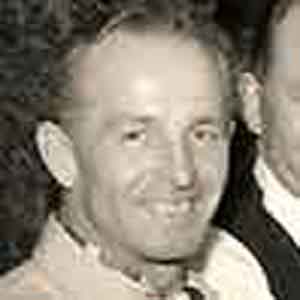
Vernon Crompton Woodward from Wikipedia, the free encyclopedia
"Woody" Vernon Crompton Woodward DFC and Bar RAF (22 December 1916 - 26 May 2000) was a Canadian who flew for the RAF as a fighter pilot during WWII. With 18 and 4 shared destroyed, 2 unconfirmed destroyed, 3 probables, and 11 damaged, Woodward tied Henry Wallace McLeod as Canada's second highest scoring pilot of the war.
Born in Victoria, British Columbia, Woodward was unable to join the RCAF as he did not have a degree. He sailed for the UK in 1938 and resided in Gloucestershire farming. After attending the Civil Flying School in Perth, Scotland by August 1938 he was accepted on a short service commission in the RAF as an Acting Pilot Officer. In September 1938 he attended 6 FTS at Little Rissington.
Woodward was posted to No. 33 Squadron RAF in Egypt in May 1939. He became a Flying Officer in September. Following Italy's entry into the war in June 1940, he was to gain early successes over Libya during June-July 1940.
He gained more success during December, by which time the squadron had re-equipped with Hawker Hurricanes. Late in February 1941 the squadron moved to Greece. On 9 May he was decorated with the Distinguished Flying Cross.
Late in April Woodward was ordered to Egypt to bring back a reinforcement Hurricane. He rejoined the Squadron, now in Crete, in May 1941 as a flight commander. The unit personnel retreated on foot across the island after the German invasion, and were evacuated on a Royal Navy destroyer later in the month.
The squadron reformed in June and was back in action, supporting Operation Battleaxe, with a flight of experienced pilots from 33 Squadron led by Woodward attached to No. 274 Squadron.
On 11 September his tour expired and he was sent to Rhodesia to become instructor at 20 SFTS, Cranbourne, Salisbury until June 1942, when he was posted to the Training Group HQ in Salisbury on Air Staff duties.
On 2 July 1942 Woodward was promoted to Squadron Leader, and in January 1943 he returned to Egypt to command No. 213 Squadron until August 1943. A Bar to his DFC was awarded on 6 August 1943.
After he went to AHQ, Levant, before attending the Middle East Staff College, Haifa in September. In December he was posted to HQ, Middle East on staff duties, and promoted to Wing Commander in June 1944.
In February 1945 he took command of the Mediterranean Middle East Communications Squadron, flying various transport aircraft.
In December 1946 he returned to the UK, going to the Visual Interservice Training and Research Establishment as Chief Ground Instructor.
In 1947 he joined CFE as SASO, and in August commanded No. 19 Squadron until March 1950. He then was posted to HQ, Fighter Command, in September 1950. Various peace time posts followed, until following a difference of opinion with a superior (see more below), he was moved to command No. 69 (PR) Squadron on Canberras in 1958. He remained with this unit until October 1959, when he went to the Ministry of Aviation, Controller of Aircraft, as SAdO.
He retired in January 1963 and settled in Australia, where he formed an air charter company.
In August 1967 he returned to British Columbia in retirement as a member of the Corps of Commissionaires.
References: "Canadian Aces of WW2" by McCaffery, Dan. Air Aces: "The Lives and Times of Twelve Canadian Fighter Pilots". ISBN 1550283219.
Article from Air Mail dated June 2003 by Andrew Thomas.
DESERT FIRST - The RAF's first victory in the desert war.
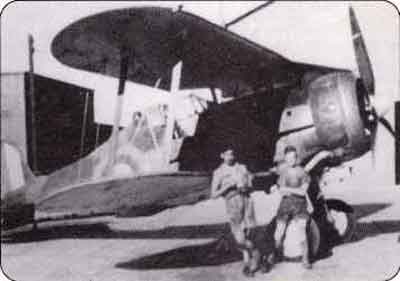
When the Italian Government declared War on Britain and its empire on 10 June 1940, the forces of the two new protagonists faced each other on several fronts. In the North African desert Italian forces in Libya confronted the British on the Egyptian border whilst those in the Italian territories in East Africa prepared for action against the British and Commonwealth units in Aden, Kenya, the Sudan and British Somaliland. The first Italian aircraft to fall was during a night raid on Aden on the Red Sea during the night of the 13th when Fg Off Gordon Haywood of No 94 Sqn in Gladiator N5590 shot down the S.81 bomber of the 4th Gruppo which was flown by SottoTenentte Paolelli. The Italian crew were captured and began their captivity by being entertained in the Officers' Mess.
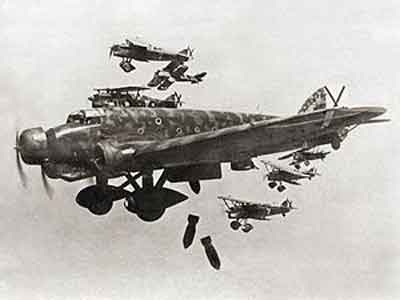
The Savoia-Marchetti SM.81 Pipistrello was the first three-engine bomber/transport aircraft serving in the Italian Regia Aeronautica.
In the desert the RAF had three more fighter squadrons, also equipped with the biplane Gladiator, which was comparable to their Italian equivalent, the Fiat Cr 42 but with a performance advantage over the earlier Fiat Cr 32, albeit the latter was blessed with unsurpassed manoeuvrability. The longest serving of the RAF units in Egypt wan No 33 Sqn based at Mersa Matruh, about 120 mires east of the frontier and was commanded by Sqn Ldr D V Johnson. Previously equipped with light bombers for policing duties, in February 1933 it had re-equipped with Gladiators and converted to the fighter role for the air defence of Egypt and the vital Suez Canal. Many of its pilots, hoverer, had already seen action during the policing duties in Palestine in 1938 when 'C' Fight had detached to Ramalah to assist policing during the virtual civil war between Arab and Jew in which the British Forces attempted to maintain order. Typical was the action on 1 October when an emergency call for air support from the Army came in. Plt Off Foster, Sgt Vale and Sgt Tebbs scrambled and attacked a croup causing 12 casualties; one Gladiator was hit in the tailplane. Thereafter there were regular patrols and strafing attacks but these were not without risk as happened on 1 November when the new CO Sqn Ldr Hector McGregor and four others conducted during an air cordon operation at Beit Fulk. However, as a result of enemy sniping Sgt Tebbs crashed and was critically injured though he wan rescued' he later died. Operations continued through November on a large scale in support of the 7th Division and when No 33 eventually withdrew it had lost two pilots and won several decoratIons, including the DSO for the CO. Amongst its pilots to see action were several who later became notable, including a young Canadian, Plt Off 'Woody Woodward.
Fiat CR.32 Fiat CR.42 Falco.
The other pre-war Gladiator squadron was No 80 and it too saw some action in Palestine: one was the main now recognised as the leadng RAF ace of WW2, Fg Off 'Pat' Pattle. Another young plot on No 80 was Plt Off Ernest Dean, nicknamed 'Dixie' who flew in the Squadron's four-ship aerobatic team alongside Pattle of whom he recalled: "Pattle was the adjutant, a quiet, pleasant South African, but what a superb pilot he was - leading the acrobatic 4 with John Lapsley, Peter Wykeham-Barnes and 'Trader' Horne. When after moving to our war station and got down to air to air gunner 'Pat' showed his superiority in deflection shooting in gaining many more hits than any of the other plots in the squadron".
Dean, however, was to find action, and a unique place in RAF history with No 80's rival squadron, No 33 after he had moved across in April 1940. He recalled his move and his appointment to command 'C' Flight to the author: "Soon after being promoted to Fg Off, I was posted to No 33 Sqn at Mersa Matruh and soon replaced Flt Lt Bolingbroke who was killed reconnoitring Sidi Barrani for use as a forward Landing Ground. He was landed in a fairly thick fog there and unfortunately died. I had a good Flight with Verne Woodward, Peter Wickham and Sgt Craig. It wasn't long after Italy declared war and we were moved to Sidi Barrani. We had no warning system at all on aircraft movement of the enemy and very sketchy and vague locations of both ours and their positions from the Army. We carried out the old traditions of patrolling along and over the border in the begining in 'vics' and pairs. Later we had bigger sweeps with more aircraft".
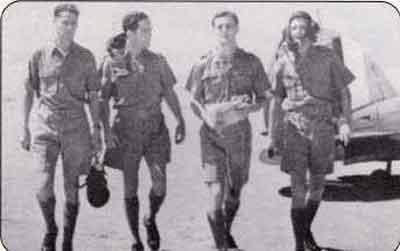
The four pilots involved in No. 33 Sqn's historic actions of 14Jun40: L to R: Sgt J. Slater, Fg. Off. E. H. Dean, Plt. Off. V. C. Woodward and
Plt. Off. A. R. Castello. Photo: Andrew Thomas.
No 33 had began its first patrols on I1 June from Mersa Matruh but these were, initially uneventful, as laconically noted the Squadron's Operations Record Book (ORB): "11 Jun 40 - From Mersa Matruh - patrols carried out, no contacts". Two days later, however, Deans Flight was detached further forward to Sidi Barrani which was only about 50 miles from the Libyan border and on the 14th, the day after arriving, Dean's Gladiators were to find the Italians. At 07.35 on 14 June 'Dixie' Dean with Fg Ott R A Couchman, 'Woody' Woodward and Pit Off Alfred Costello left Sidi Berrani for a patrol. On their return almost 2 hours later they reported No 33's first success, the three of them having made a low flying attack on a Caproni 310 Ghibli bomber on the ground at Sidi Aziez landing ground about 10 miles south west of the Libyan port of Bardia.
Caproni Ca.309 Ghibli
The disabled bomber was later captured by advancing British troops the Gladiators were quickly refuelled and 35 minute later Dean, flying Gladiator N5782 led off Woodward in N5783, followed a few minutes later by Sgt J Craig in N5768 for another patrol. Over the frontier near Fort Capuzzo the trio encountered two Ca 310s from the 159th Squadriglia of the 12 Gruppo, one of which was flown by Sargente Maggiore Stefano Garrisi and which were escorted by Flat Cr 32s from 93a Squadriglia of 8 Gruppo.
Caproni Ca.310B
The Squadron's ORB briefly noted a landmark event thus: "0955 F/O E H Dean (N5782), P/O V C Woodward (N5783) and Sgt Craig (N5768), t/o to Capuzzo to support Army advance".
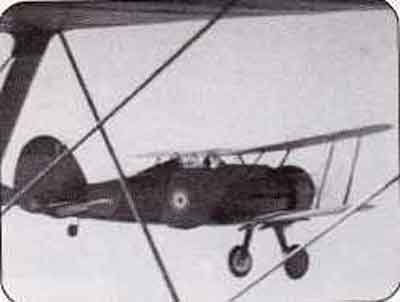
One of the two 33 Sqn's Gladiators on patrol over the Libyan bordering mid 1940. Photo: Andrew Thomas.
The bare facts can he enlivened by 'Dixie' Dean's recollection Of his first air to air combat which he described to the author. "The combat of the 14th June near Fort Capuzzo was our very first encounter with the enemy. An inoffensive looking light bomber was seen, and I detached Woodward and Sgt Craig to attack, whilst I stayed aloft to cover. Within a short spell I saw six aircraft in line astern heading from the west. I recognised them as Cr 32's. I remember being quite calm and wondering what the heck to do. I flew towards them well to my right - with the thought of getting behind them (and shooting them down one by one - silly boy!) Before I got close enough to them they split in all directions and formed a ring around me the sitting duck! I remembered somewhere about flying extraordinarily badly to present a very bad target. I throttled back, yawed and waffled up and down and around, and could hear the thump of their _ inch cannon at each pass, and as each came into my sights having a rapid squirt at them. This seemed to go on for ages and eventually one of them dropped away and suddenly the remainder disappeared and I was thankfully alone in the sky and flew back. I heard on my return to base and debriefing that one Cr 32 had been destroyed, apparently by me, and Woodward and Craig had shared the bomber. I did hear later that the pilot of the Cr 32 had one bullet though the heart". His victim was Sergente Edoardo Azzaroni who was indeed killed and whose Fiat Cr 32 was the first aircraft brought down by the RAF n the countless air combats that were to take place over the desert during the next three years. The second victory soon followed as Woodward and Craig attacked Garrisi's Caproni from the same altitude as they passed, setting one of the engines on fire and it crash-landed among British tanks near Fort Capuzzo. The only damage sustained by the three Gladiators was to Woodward's aircraft that returned with a single bullet hole in one of the wings.
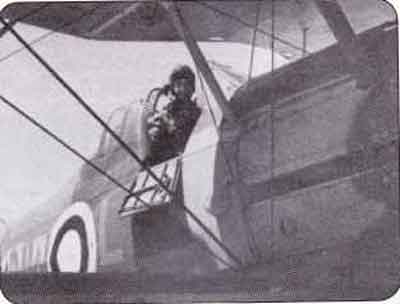
Plt. Off. 'Woody' Woodward in the cockpit of the Gladiator N5784 /NW-L of No 33 Sqn in September 1940. Photo: Andrew Thomas.
It was the first of five victories for Dean, who recalled the Italian fighters he encountered thus: "The CR 32 which, although armed with heavy cannon, was under-powered and slow and the pilots weren't very keen. The CR 42 and the Gladiator were fairly evenly matched and the CR 42 pilots were better too, much more of a match for the RAF pilots. The CR 42 had a constant speed airscrew whilst the Gladiator had a fixed pitch screw so this gave the CR 42 a much better rate of climb and a higher flat out diving speed. The Gladiator had slightly better manoeuvrability and the four Browning machine guns were superior to the 12.7mm cannon in the CR 42. The Italians used explosive ammunition, which tended to explode an impact with little penetration."
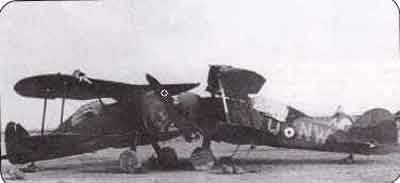
Two of No 33's Gladiators after a 'brief' encounter in the desert in 1940. L7814/NW-O being nearest. Photo: Andrew Thomas.
Vernon Woodward later recalled of this landmark combat: "...meeting the Capronis at the same altitude as the Gladiators and attacked one, aiming for the engines. When a motor began smoking, the Italian crew crash-landed among British tanks near Fort Capuzzo. During the battle a single bullet had missed my head by inches - the hole being visible though one wing". He too became an ace and eventually had a score of 22 victories, four of which, like this first one, were shared'
Gerry Shipley's Notes: "I was dined in on the same night as Hammer West's replacement (Vic Woodward). I remember parts of the evening very well, especially when Sandy Sanderson became irritated that the new Wing Commander repeatedly beat him at leg-wrestling. Sandy showed his displeasure by picking Vic up and dropping him on to the anteroom floor from shoulder height.
At this point the Wg Cdr disappeared and there was general displeasure that the new boss should be a wimp; however, he returned about 30 minutes later, having been to sick quarters to get attention for his broken collar bone and complaining about the handicap of now having to drink left-handed. As a typical 20 year old know-all, I assumed that the Wingco Flying was clearly old, past it and definitely boring.
Not too long ago, I put his name into Google and was surprised to find that he had had a much more interesting history than I'd given him credit for; his achievements include being listed among the RAF BIPLANE aces of WW2. When he came to Jever I don't think he can have had much previous jet experience, I remember him leading us in a 24-ship formation one day and initially proposing to fly at 180 knots IAS "so as to ensure the rest of us had plenty of performance in hand". He was a bit taken aback when we suggested 300 would be a more comfortable airspeed, but was happy to oblige. In retrospect I know I underrated him at the time, anyone with 20 WW2 kills in Gladiators and Hurricanes was obviously an OK bloke and anyone whom Sid disapproved of was clearly "the right stuff".
|